Table of Contents
Staying connected is important for seafarers, Merchant Navy crew, sailors, and maritime workers who spend weeks or months travelling between countries. Whether you want to contact your family, use navigation apps during shore leave, access online banking, or stay connected while visiting ports, having reliable mobile data can make international travel much easier.
A maritime eSIM provides a convenient way to access supported mobile networks without purchasing and replacing physical SIM cards every time you visit a new country.
But does a maritime eSIM work at sea? Can seafarers use an eSIM? How does it compare with a traditional maritime SIM card? And what should you check before buying one?
This complete guide explains how maritime eSIMs work and what seafarers should know before choosing a plan.
What Is a Maritime eSIM?
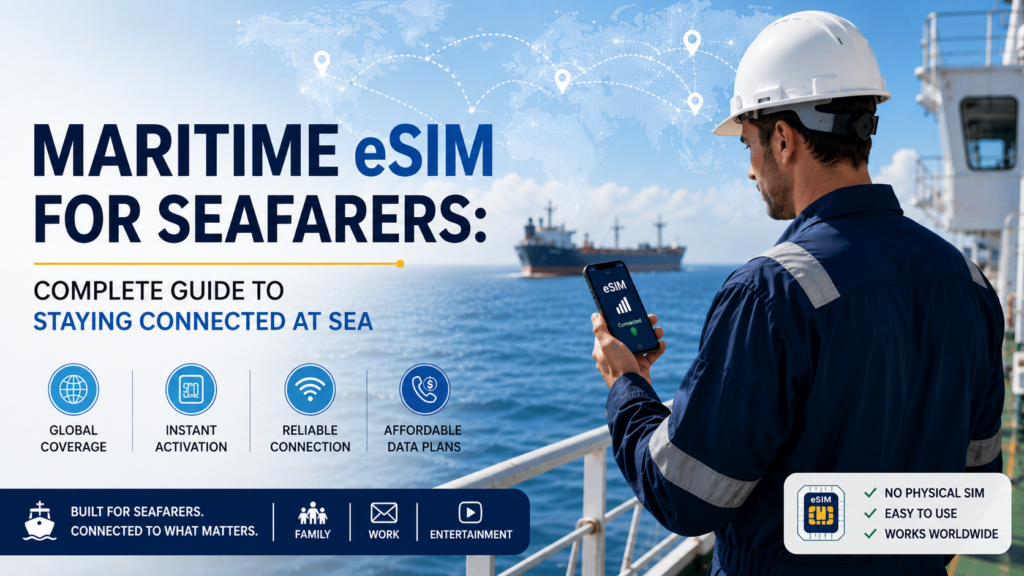
A maritime eSIM is a digital SIM that allows seafarers and maritime workers to connect to supported cellular networks without inserting a physical SIM card into their smartphone.
An eSIM, or embedded SIM, is built directly into compatible smartphones and devices. Instead of purchasing a physical SIM card, you can buy an eSIM plan online and install it digitally.
For seafarers who travel between different ports and countries, this can be more convenient than purchasing a new SIM card at every destination.
For example, a crew member may travel through countries such as:
- United Kingdom
- Germany
- Spain
- Singapore
- United Arab Emirates
- India
- Japan
- Brazil
- Australia
Depending on the plan, an international eSIM may provide mobile data across multiple supported destinations.
However, coverage varies by provider and plan, so always check the included countries and networks before purchasing.
Can Seafarers Use an eSIM?
Yes. Seafarers can use an eSIM if their smartphone supports eSIM technology and the selected plan provides coverage in their destination.
Before purchasing an eSIM for seafarers, check these requirements:
- Your smartphone must support eSIM.
- Your device should be carrier-unlocked where required.
- Your destination should be included in the eSIM plan.
- The provider should have a supported mobile network in that destination.
- Check whether the plan provides data only or also supports calls and SMS.
- Check the validity period and activation rules.
- Confirm whether mobile hotspot is supported.
For most maritime workers, coverage and network availability are more important than simply having an eSIM-compatible phone.
Does a Maritime eSIM Work at Sea?
This is one of the most common questions about maritime connectivity.
A standard cellular maritime eSIM does not automatically provide internet access in the middle of the ocean.
Most travel eSIMs connect through terrestrial mobile networks. When a vessel is close enough to land and within range of a supported cellular network, your eSIM may connect to that network.
An eSIM can therefore be useful when:
- Your vessel is approaching a port.
- You are docked at a port.
- You are travelling through coastal areas.
- You are on shore leave.
- You are close to a supported terrestrial network.
- You are travelling between supported destinations.
When the vessel moves far offshore and leaves terrestrial cellular coverage, a standard cellular eSIM may stop working.
Maritime eSIM vs Satellite Connectivity
An eSIM and satellite connectivity serve different purposes.
A cellular eSIM connects your smartphone to supported terrestrial mobile networks.
Satellite connectivity uses satellite infrastructure and can provide communication where terrestrial mobile networks are unavailable, depending on the vessel’s equipment and service.
Therefore, a maritime eSIM should not be considered a replacement for onboard satellite internet.
Instead, it can be a useful mobile connectivity solution when supported cellular networks are available.
Maritime eSIM vs Maritime SIM Card
A traditional maritime SIM card can still be useful for seafarers. However, physical SIM cards can become inconvenient when travelling between multiple countries.
With an eSIM, you don’t need to physically remove and replace the SIM card every time you change destinations.
| Feature | Maritime SIM Card | Maritime eSIM |
|---|---|---|
| Physical SIM required | Yes | No |
| Installation | Insert SIM | Digital installation |
| Physical replacement | Required when changing SIM | Not normally required |
| Multiple profiles | Limited | Supported on compatible devices |
| Risk of losing SIM | Possible | No physical card |
| Online activation | Usually not | Usually available |
| International travel | Suitable | Particularly convenient |
The best option depends on your phone, travel schedule, destination and connectivity needs.
For seafarers who regularly visit different countries, an eSIM can offer greater convenience.
Benefits of Using a Maritime eSIM for Seafarers
1. No Physical SIM Card
One of the biggest advantages of an eSIM is that there is no physical SIM card to carry.
You don’t have to worry about losing a tiny SIM card while travelling or storing several cards for different countries.
2. Easy Digital Activation
An eSIM can normally be purchased online and installed digitally.
Depending on the provider, activation may involve scanning a QR code or following instructions through an app or your phone’s settings.
This means you can prepare your connectivity before reaching your next destination.
3. Convenient for International Travel
Seafarers can visit several countries during a single voyage.
A regional or global eSIM can potentially cover multiple supported destinations, reducing the need to purchase separate physical SIM cards.
4. Keep Your Existing SIM
Many eSIM-compatible smartphones support dual-SIM functionality.
This may allow you to keep your regular SIM active while using an eSIM for mobile data.
This can be useful if you want to continue receiving important calls or messages on your normal number.
5. No SIM Swapping
With a physical SIM card, changing providers requires removing one SIM and inserting another.
An eSIM eliminates this physical swapping process on compatible devices.
6. Useful During Shore Leave
Seafarers often have limited time when visiting a port.
Having an eSIM already installed can make it easier to access:
- Google Maps
- Online banking
- Ride-hailing services
- Translation apps
- Travel apps
- Social media
- Video calls
What Should Seafarers Look for in a Maritime eSIM?
Not every eSIM plan is suitable for maritime workers.
Before purchasing a seafarer eSIM, consider these factors.
Coverage
Coverage should be your first priority.
Check whether the countries and destinations you expect to visit are included in the plan.
If your voyage includes several regions, a regional or global eSIM may be more convenient than a single-country plan.
Supported Networks
Check which mobile networks the eSIM provider uses in each destination.
An eSIM that supports multiple networks may provide greater flexibility where several networks are available.
Data Allowance
Consider how much data you actually need.
Light users who mainly use messaging apps and maps may need only a few gigabytes.
Users who regularly make video calls, upload content or stream videos will need more data.
For example:
- 1–3 GB: Light usage
- 5–10 GB: Moderate usage
- 10–20+ GB: Heavy usage
Your actual requirements will depend on your usage and whether Wi-Fi is available onboard.
Plan Validity
Check how long the plan remains active.
Some eSIM plans are valid for a few days, while others can last for weeks or months.
Choose a validity period that matches your travel or voyage schedule.
Hotspot Support
If you need to connect a laptop, tablet or another device through your smartphone, check whether the eSIM supports hotspot or tethering.
Activation Requirements
Before purchasing, check how the eSIM needs to be installed and activated.
It may require:
- QR-code scanning
- Mobile app installation
- Manual APN configuration
- Internet access during installation
- Device settings changes
Installing your eSIM before leaving a port can help avoid connectivity problems later.
How Much Does a Maritime eSIM Cost?
The cost of a maritime eSIM depends on the provider, destination, data allowance, validity and coverage.
A small single-country plan may cost less than a regional or global plan with a larger data allowance.
When comparing plans, don’t look only at the price.
Instead, compare:
- Price per GB
- Total data allowance
- Validity period
- Countries covered
- Supported networks
- Hotspot availability
- Activation requirements
The cheapest eSIM isn’t necessarily the best option if it doesn’t cover the destinations you need.
Maritime eSIM for Merchant Navy Crew
A Merchant Navy eSIM can be useful for crew members who travel internationally and visit multiple ports during their contracts.
For example, a crew member could travel between Singapore, the UAE, India and European ports.
Instead of buying a separate physical SIM card at each destination, an international eSIM may provide data across multiple supported countries.
However, always check the exact coverage before purchasing.
The term “global eSIM” does not necessarily mean that every country, mobile network or offshore location is included.
How to Buy a Maritime eSIM
Buying an eSIM for seafarers is generally straightforward.
Step 1: Check Your Smartphone
First, confirm that your phone supports eSIM.
You should also check whether the device is carrier-unlocked if required.
Step 2: Choose Your Destinations
Determine where you need mobile connectivity.
You may need:
- A single-country eSIM
- A regional eSIM
- A global eSIM
Step 3: Compare eSIM Plans
Compare the following:
- Data allowance
- Price
- Validity
- Coverage
- Supported networks
- Hotspot availability
Step 4: Purchase the eSIM
Purchase your selected plan online.
After purchase, you will normally receive installation instructions.
Step 5: Install the eSIM
Follow the provider’s instructions to install the eSIM on your smartphone.
It’s recommended to install the eSIM before you need it, particularly if you may have limited internet access later.
Step 6: Activate the Plan
Activation depends on the provider.
Some plans activate when installed, while others activate after connecting to a supported network.
Always check the provider’s activation instructions.
How Can Seafarers Save Mobile Data?
Even with an affordable eSIM, mobile data can disappear quickly.
You can make your data plan last longer by:
- Downloading maps before travelling.
- Downloading music and videos over Wi-Fi.
- Turning off automatic app updates.
- Disabling automatic photo backups over mobile data.
- Using Wi-Fi whenever available.
- Turning off video autoplay.
- Monitoring your mobile data usage.
- Downloading entertainment before leaving port.
These simple steps can help you get more value from your eSIM plan.
Is a Maritime eSIM Better Than a Local SIM?
There is no single answer for every seafarer.
A local SIM can be a good choice if you spend a long period in one country and need a local phone number.
An eSIM may be more convenient if you:
- Travel between several countries.
- Frequently change ports.
- Don’t want to carry physical SIM cards.
- Want to purchase connectivity online.
- Have an eSIM-compatible smartphone.
- Mainly need mobile data during shore leave and port visits.
For international travellers and seafarers, the convenience of an eSIM can make it an attractive alternative to purchasing multiple physical SIM cards.
Frequently Asked Questions About Maritime eSIM
Can seafarers use an eSIM?
Yes. Seafarers can use an eSIM if their smartphone supports eSIM technology and the selected eSIM plan provides coverage in their destination.
Does a maritime eSIM work in the middle of the ocean?
Usually, no. A standard cellular eSIM relies on terrestrial mobile networks. When a ship travels beyond cellular coverage, the eSIM may not connect. Satellite connectivity may be required for offshore communication.
Can I use an eSIM on a Merchant Navy vessel?
Yes, if your smartphone supports eSIM and the plan provides compatible cellular coverage. Your ability to connect onboard depends on your location and the availability of terrestrial mobile networks.
Is a maritime eSIM better than a physical SIM card?
An eSIM can be more convenient for international travel because it doesn’t require a physical card. However, the best option depends on your device, destination and connectivity requirements.
Can I use my normal SIM and an eSIM together?
Many modern smartphones support physical SIM and eSIM functionality together. The exact features depend on your smartphone model.
How much data does a seafarer need?
It depends on your usage. Light users may need only a few gigabytes, while users who frequently stream video or make video calls may need considerably more.
Does an eSIM provide offshore internet?
A standard cellular eSIM does not automatically provide offshore internet. It requires access to a compatible terrestrial mobile network. For far-offshore connectivity, onboard Wi-Fi or satellite communication may be required.
Final Thoughts
A maritime eSIM can be a convenient connectivity solution for seafarers, Merchant Navy crew, sailors and maritime workers who regularly travel between countries.
Instead of carrying several physical SIM cards, an eSIM allows compatible smartphones to store and activate digital mobile plans. This can make international travel easier, especially when visiting different ports.
However, it is important to understand the limitations. A standard cellular eSIM relies on supported terrestrial mobile networks and does not replace satellite connectivity when a vessel is operating far offshore.
Before buying a maritime eSIM, compare coverage, supported networks, data allowance, validity, hotspot support and price.
For seafarers who regularly travel internationally, preparing the right eSIM before joining a vessel or arriving at a new port can make it easier to stay connected with family, work and essential online services.
Stay Connected With Mapians
Looking for a convenient eSIM for your next international journey?
Explore Mapians eSIM plans and choose a plan based on the countries and destinations you expect to visit.
Remember: Always check the latest coverage and supported networks for your specific destination before purchasing an eSIM.