Table of Contents
You finally get shore leave after weeks at sea. You have a few hours before the vessel sails again, and there are probably a dozen things you want to do call home, grab something to eat, book a taxi, check Google Maps, withdraw money, or simply catch up with friends.
Then comes the problem: you need mobile data.
Finding a local SIM card at every port can be frustrating, especially when your time ashore is limited. You may have to find a mobile shop, deal with registration, compare plans in a foreign currency, and then figure out how to activate the SIM.
This is where an eSIM for port calls can make life easier.
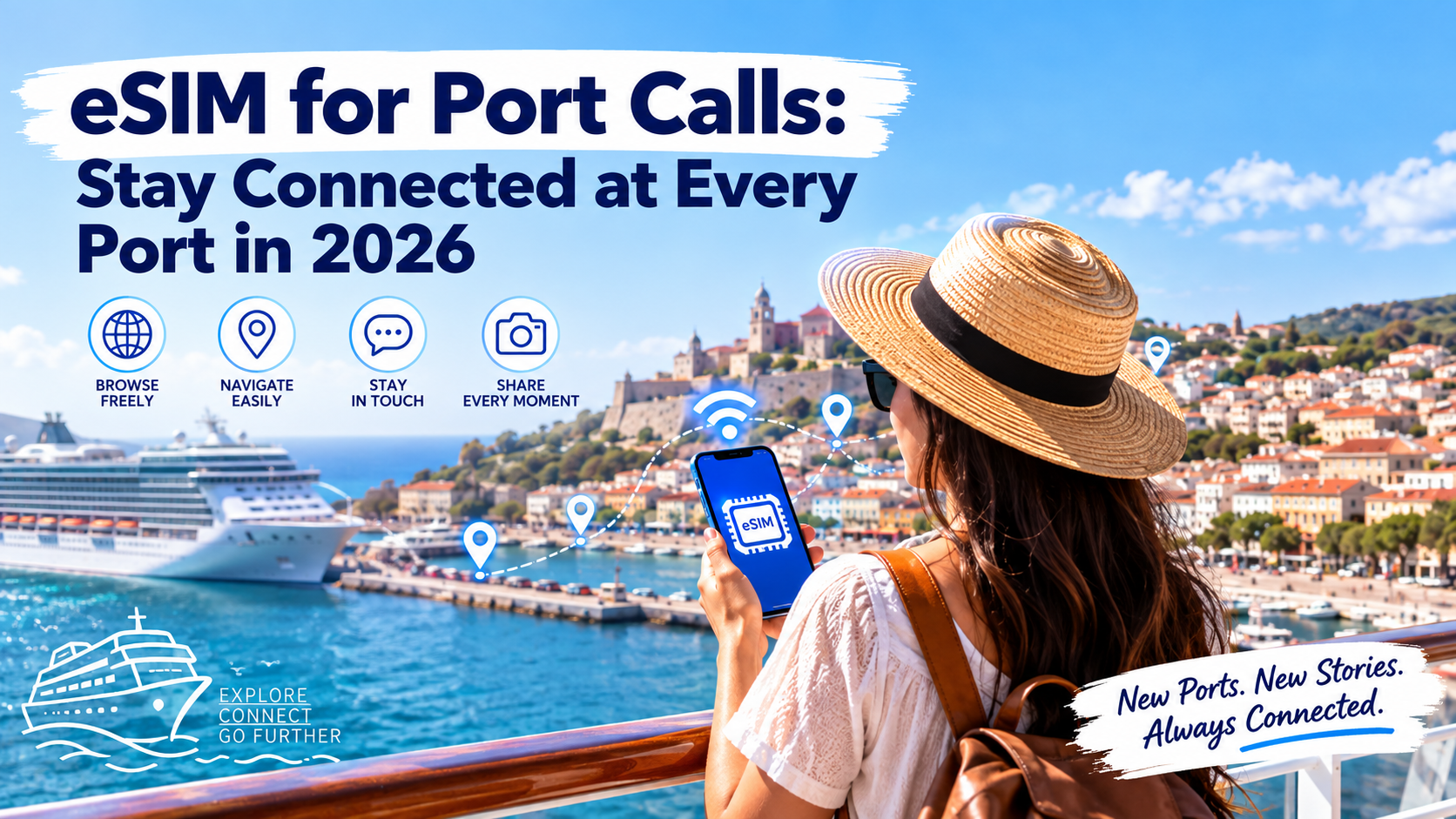
With a compatible phone, you can buy an eSIM online and set it up before reaching your destination. When your vessel arrives at a supported port and your phone picks up a compatible mobile network, you can use your eSIM for mobile data without changing your physical SIM card.
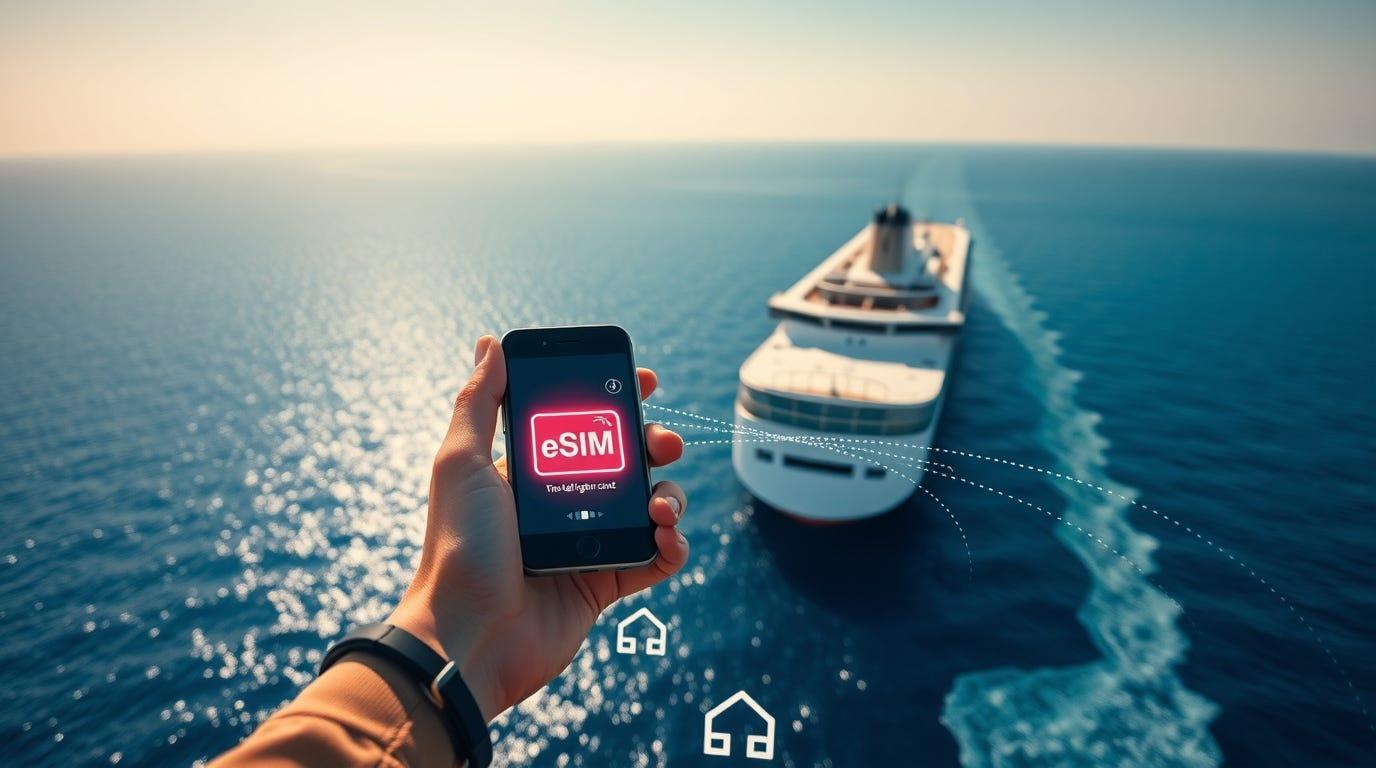
But there is an important limitation: a normal travel eSIM is not designed to provide cellular service in the middle of the ocean. It relies on land-based mobile networks, so it is mainly useful during port calls, shore leave, and supported coastal areas.
Let’s look at how it works and what seafarers should consider before buying one.
What Is an eSIM for Port Calls?
An eSIM is a digital version of a SIM card built into your phone. Instead of receiving a physical SIM and inserting it into your device, you download an eSIM profile and activate it digitally.
For seafarers, an eSIM for port calls is particularly useful because your travel pattern is different from that of a typical tourist.
You might visit Singapore this week, Dubai next week, and a European port after that. Buying a new physical SIM every time isn’t always practical.
Depending on the route, you can choose a:
- Country eSIM for one destination
- Regional eSIM for several countries in the same region
- Global eSIM for multiple destinations worldwide
The right choice depends on your vessel’s itinerary and how much data you need.
Can Seafarers Use an eSIM During Port Calls?
Yes. Seafarers can use an eSIM during port calls if their device supports eSIM and the selected plan covers the destination and available mobile network.
Once you are within mobile network coverage, you can use your eSIM for everyday activities such as:
- WhatsApp messages and calls
- Video calls with family
- Google Maps
- Taxi and transport apps
- Online banking
- Social media
- Web browsing
- Checking flights
- Finding restaurants and shops
For a short port call, this can be much more convenient than looking for a physical SIM after getting ashore.
Does an eSIM Work at Sea?
This is where many people get confused.
An ordinary travel eSIM does not provide full mobile coverage in the open ocean.
Your eSIM connects to terrestrial cellular networks. These are the same types of mobile networks your phone uses on land.
So, in simple terms:
At the port: eSIM can work if the destination and network are supported.
Near the coast: It may work while you’re within range of a supported terrestrial network.
In the middle of the ocean: A normal travel eSIM generally won’t work because there is no terrestrial cellular network to connect to.
For offshore connectivity, ships generally use onboard Wi-Fi and satellite-based communication systems.
Think of it this way:
eSIM = connectivity when you’re near supported land-based mobile networks.
Ship Wi-Fi/satellite = connectivity when you’re offshore.
An eSIM isn’t a replacement for your vessel’s satellite internet. Instead, it can be a convenient option when you’re going ashore.
Why Do Seafarers Use eSIMs During Port Calls?
The biggest advantage is simple: you can prepare before you arrive.
You Don’t Have to Find a SIM Shop
Imagine your vessel arrives at a port at 8 a.m. and you’re allowed to go ashore for only a few hours.
You probably don’t want to spend the first hour looking for a telecom store.
With an eSIM, you can arrange your data plan before the vessel reaches port.
You Can Stay Connected With Family
For many seafarers, calling home is one of the most important things to do during shore leave.
An eSIM can provide mobile data for WhatsApp, Messenger, FaceTime, Google Meet, or other internet-based communication services, depending on your device and app setup.
You Can Use Maps
Getting around an unfamiliar city is much easier when you have mobile data.
You can check:
- Your location
- Walking directions
- Public transport
- Taxi routes
- Nearby restaurants
- Shops
- Banks
- Tourist attractions
You Can Visit Multiple Countries
A vessel may make several port calls during one voyage.
Instead of buying a new SIM at every destination, you can consider a regional or global eSIM that covers multiple countries.
You Don’t Need to Swap SIM Cards
Your physical SIM can stay in your phone.
On compatible devices, you can use your eSIM for data while keeping your regular SIM available for your existing number.
Just remember that your home carrier may still charge roaming fees for calls or data on the primary SIM.
eSIM vs Local SIM for Port Calls
So, should you use an eSIM or buy a local SIM?
Both have advantages.
| Feature | eSIM | Local SIM |
|---|---|---|
| Physical card | Not required | Required |
| Buy before arrival | Yes | Usually no |
| Visit a store | Usually not needed | Often needed |
| Good for short port calls | Yes | Less convenient |
| Multiple countries | Regional/global options | Usually separate SIMs |
| Setup | Digital | Physical |
| Keep existing SIM | Often possible | Usually requires SIM replacement |
A local SIM may be cheaper if you’re staying in one country for a long time.
But if you’re a seafarer with only a few hours of shore leave, convenience can be just as important as price.
What Is the Best eSIM for Port Calls?
There isn’t one eSIM that is best for every seafarer.
The best choice depends on your route.
Before buying, look at these six things.
1. Does It Cover Your Port?
This should be your first check.
If your vessel is calling at Singapore, UAE, India, Germany, or another destination, make sure that country is included in the plan.
Don’t rely only on phrases such as “global coverage.” Check the actual country list.
2. Which Networks Does It Use?
Network availability can make a big difference.
Two eSIM plans might both cover the same country but use different network partners.
If possible, check which networks the provider supports in your destination.
3. How Much Data Do You Need?
Don’t automatically buy the largest package.
If you mainly use WhatsApp, Maps, email, and basic browsing, you may not need much data.
If you regularly make video calls, upload videos, stream content, or use your phone as a hotspot, you’ll need more.
4. How Long Is the Plan Valid?
Check the validity period before buying.
This is especially important for seafarers because your vessel’s schedule can be different from a normal holiday itinerary.
5. Can You Top Up?
Running out of data during a port call isn’t ideal.
If possible, choose a provider that offers top-ups or additional data.
6. Is Your Phone Compatible?
Your phone needs to support eSIM.
It may also need to be unlocked to use another mobile provider.
Check compatibility before purchasing.
Country eSIM vs Regional eSIM vs Global eSIM
Not sure which type to choose?
Here’s a simple way to think about it.
Country eSIM
A country eSIM is designed for one destination.
Best for: A single port call or repeated visits to one country.
Regional eSIM
A regional eSIM covers several countries in one region.
Best for: Voyages involving several countries within the same region.
Global eSIM
A global eSIM covers multiple regions.
Best for: Seafarers travelling between different continents.
For example, if your route includes ports in Asia, the Middle East, and Europe, a global plan may be worth comparing with several individual country plans.
How Much Data Does a Seafarer Need During a Port Call?
It depends on what you plan to do ashore.
Light use
You might only need data for:
- Google Maps
- Weather
- Basic browsing
Medium use
You may need more for:
- Social media
- Photo uploads
- Music streaming
- Video calls
- Frequent browsing
Heavy use
You’ll need considerably more data for:
- HD video streaming
- Long video calls
- Large downloads
- Hotspot use
- Cloud backups
If your data allowance is limited, avoid downloading large files or streaming video while using mobile data.
A Simple Example: A Multi-Port Voyage
Imagine you’re working on a vessel travelling through:
Singapore → Malaysia → India → UAE
You could buy a separate local SIM at each port.
But that means:
Four destinations = potentially four SIM purchases
Instead, you could compare a regional or global eSIM that includes these destinations.
You install the eSIM before your voyage and use it when you’re within supported mobile coverage.
Of course, you should always check the exact countries, networks, data limits, and validity before purchasing.
How to Set Up an eSIM Before Your Port Call
The best time to set up your eSIM is before you arrive, not after.
Step 1: Check Your Phone
Confirm that your device supports eSIM and is unlocked if necessary.
Step 2: Check Your Itinerary
Write down the countries where you expect to make port calls.
Step 3: Compare Plans
Look at country, regional, and global options.
Compare:
- Coverage
- Data
- Validity
- Network access
- Price
- Top-up options
Step 4: Buy Your eSIM
Purchase your chosen plan online.
Step 5: Install It
Follow the provider’s installation instructions while you have reliable internet access.
Step 6: Configure It
When you reach the destination, select the eSIM for mobile data.
Some travel eSIMs require data roaming to be enabled, so follow the provider’s instructions carefully.
Step 7: Test Your Connection
Open a website or messaging app and make sure your data connection is working.
eSIM vs Ship Wi-Fi: Which Should Seafarers Use?
You don’t necessarily have to choose between the two.
They are useful in different situations.
| Connectivity | Best for |
|---|---|
| eSIM | Port calls and shore leave |
| Local SIM | Longer stays in one country |
| Ship Wi-Fi | Onboard internet |
| Satellite connectivity | Offshore/deep-sea connectivity |
For example:
While sailing: Use your vessel’s available onboard connectivity.
When you reach port: Use an eSIM to connect to a supported terrestrial mobile network.
This can give you a practical connectivity setup throughout your voyage.
How to Save Mobile Data During Shore Leave
A small eSIM plan can go a long way if you use it carefully.
Download maps before going ashore
Save important locations and maps whenever possible.
Turn off automatic updates
App updates can use a surprising amount of data.
Disable cloud backups
Photos and videos can quickly consume your allowance.
Avoid HD streaming
Streaming is one of the fastest ways to use mobile data.
Download entertainment before arrival
Use ship Wi-Fi or another reliable connection to download music, podcasts, or videos.
Monitor your usage
Check your phone’s data-usage settings during the port call.
Common eSIM Problems During Port Calls
An eSIM is convenient, but it doesn’t guarantee a signal everywhere.
Your eSIM won’t connect
Check whether your destination and local network are supported.
Your phone is using your regular SIM
If you have dual-SIM enabled, make sure the eSIM is selected for mobile data.
Data roaming is turned off
Some travel eSIMs require data roaming. Check the provider’s setup instructions.
Your phone is locked
A carrier-locked phone may prevent you from using another provider’s eSIM.
The port isn’t covered
Always check the exact destination before purchasing.
You’ve used all your data
If top-ups are available, you may be able to purchase additional data.
A Practical Checklist for Seafarers
Before your next port call, check the following:
- Your phone supports eSIM.
- Your phone is unlocked if required.
- Your destination is covered.
- The plan uses suitable local networks.
- You have enough data.
- The validity period fits your schedule.
- You understand when the plan activates.
- You know how to switch mobile data to the eSIM.
- You have the provider’s troubleshooting instructions available.
A few minutes of preparation can save you a lot of hassle once you’re ashore.
Frequently Asked Questions
Can seafarers use an eSIM during port calls?
Yes. Seafarers can use an eSIM during port calls when the device is compatible and the selected plan covers the destination and available terrestrial network.
Can I use an eSIM on a cargo ship?
Yes, but only when the vessel is within range of a supported terrestrial mobile network. An ordinary travel eSIM generally won’t provide cellular service in the middle of the ocean.
Does an eSIM work offshore?
A standard travel eSIM generally isn’t designed for offshore or deep-sea connectivity. It relies on land-based mobile networks.
Can I use one eSIM for multiple port calls?
Yes, if your plan covers the countries and networks at those ports. Regional and global eSIMs can be useful for multi-country voyages.
What is the cheapest eSIM for seafarers?
There isn’t one cheapest option for everyone. Compare the price against data allowance, validity, destination coverage, network availability, and top-up options.
Can I use WhatsApp with an eSIM?
Yes. WhatsApp can use your eSIM’s mobile data for messages, calls, and video calls.
Can I keep my normal SIM while using an eSIM?
Many compatible phones support a physical SIM and an eSIM simultaneously. This allows you to keep your regular number while using the eSIM for data, depending on your device and carrier.
Is an eSIM better than a local SIM for a short port call?
It can be. The main advantage is convenience because you can arrange the eSIM before arriving instead of spending shore leave looking for a local SIM shop.
Should I install an eSIM before reaching port?
Yes. Installing it in advance can make the process much easier. However, check the provider’s activation policy so you know when the validity period begins.
What is the best eSIM for Merchant Navy crew?
The best option depends on your voyage. Check destination coverage, supported networks, data allowance, validity, activation rules, device compatibility, and price before choosing.
Final Verdict: Is an eSIM Worth It for Port Calls?
If you’re a seafarer who regularly makes international port calls, an eSIM can be a very practical way to stay connected.
The biggest benefit isn’t simply avoiding a physical SIM card. It’s being able to prepare your connectivity before you arrive.
You can step off the vessel with your mobile data ready for maps, transport, banking, communication, and keeping in touch with family.
Just remember the key limitation:
A normal travel eSIM is for supported terrestrial mobile networks—not deep-sea connectivity.
For the best experience, combine your connectivity options:
At sea: onboard Wi-Fi or satellite connectivity
At port: eSIM/mobile network
Long stays: consider a local SIM or longer-term local plan
Stay Connected on Your Next Port Call With Mapians
Heading to an international port?
With Mapians, you can explore eSIM options for supported destinations and choose a plan based on your voyage, data requirements, and travel needs.
Check your destination coverage, choose the right data allowance, and install your eSIM before reaching port.
Less time looking for a SIM. More time enjoying your shore leave.