Table of Contents
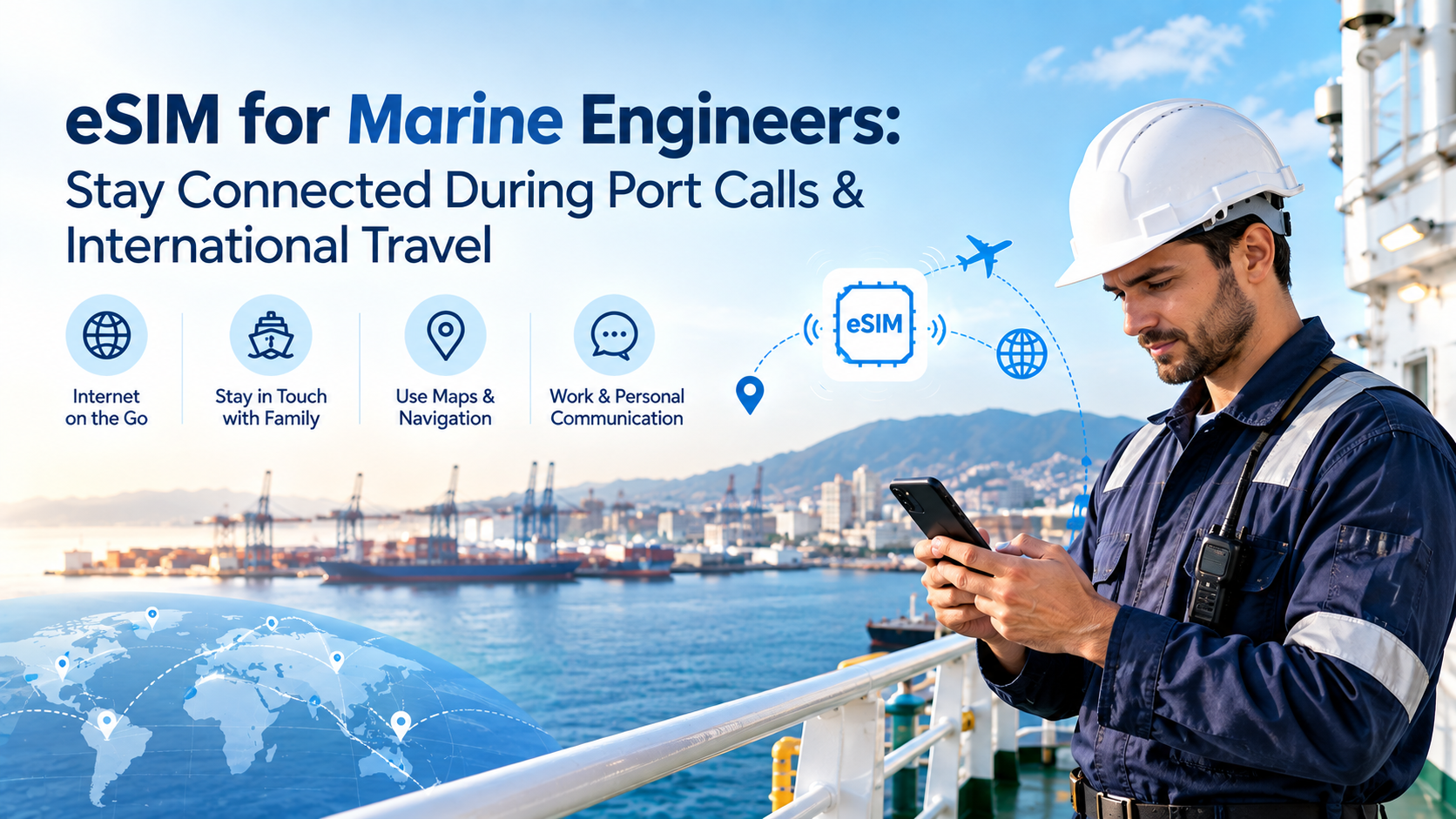
Marine engineers spend much of their working life moving between vessels, ports, countries, and crew-change locations. Reliable mobile data becomes especially useful when travelling to join a vessel, during port calls, on shore leave, or while moving between airports, hotels, and ports.
An eSIM for marine engineers provides a convenient way to access mobile data in supported destinations without buying and changing a physical SIM card every time you enter another country.
However, there is one important point to understand: a standard travel eSIM does not create mobile coverage in the middle of the ocean. It normally connects to supported terrestrial mobile networks. Once a vessel moves beyond those networks, onboard Wi-Fi or maritime satellite connectivity may be needed.
For marine engineers who regularly travel internationally, the practical approach is to use an eSIM for land-based connectivity and combine it with the vessel’s onboard connectivity when offshore.
Quick Answer: Is an eSIM Useful for Marine Engineers?
Yes. An eSIM can be useful for marine engineers during:
- Port calls
- Shore leave
- Crew changes
- International flights
- Airport transfers
- Hotel stays
- Travel between ports
- Coastal areas where supported mobile networks are available
- Joining and leaving a vessel
A standard travel & best eSIM for seafarers relies on mobile networks rather than satellites. Therefore, it should not be considered a replacement for a vessel’s onboard internet or satellite communication system.
When the vessel is in a supported port, your phone can connect to a compatible local network through the eSIM. When the vessel moves into open water and terrestrial cellular coverage disappears, you may need ship Wi-Fi or another maritime eSIM connectivity service.
Why Marine Engineers Need Reliable Mobile Data
Marine engineers have different connectivity requirements depending on where they are in their rotation.
A typical journey might involve:
Home → Airport → Transit country → Port city → Vessel → Multiple international ports → Sign-off → Airport → Home
During this journey, mobile data can help with both personal communication and travel-related tasks.
1. Staying in contact with family
WhatsApp, messaging apps, voice calls and video calls allow engineers to stay connected with family while travelling between countries.
During shore leave, mobile data can be particularly useful when Wi-Fi is unavailable or unreliable.
2. Crew-change communication
Crew changes can involve flights, hotels, agents, transportation and last-minute schedule changes.
Having mobile data available can help engineers:
- Contact the crewing agency
- Receive travel updates
- Check flight information
- Share their location
- Contact the port agent
- Use transportation apps
- Access email and documents
3. Navigation in unfamiliar ports
When arriving in a new country, Google Maps or another navigation service can help you find:
- Airports
- Hotels
- Port gates
- Transport
- Restaurants
- Banks
- Shops
- Hospitals
- Local services
4. Online banking and payments
Marine engineers travelling internationally may need access to banking applications, payment services and account notifications.
A reliable mobile connection can be useful when public Wi-Fi isn’t available.
5. Work-related communication
Depending on company policies and onboard systems, engineers may occasionally need mobile data for email, messaging, document access or communication with shore-based contacts.
For sensitive company systems, always follow your employer’s cybersecurity and communication policies.
Does an eSIM Work for Marine Engineers at Sea?
This is one of the most important questions to understand before purchasing an eSIM.
A standard travel eSIM is not a satellite connection.
An eSIM is simply a digital SIM profile that allows your device to connect to supported mobile networks. If there is no compatible terrestrial network available, the eSIM cannot manufacture a cellular signal.
The basic difference is:
| Location | Typical connectivity |
|---|---|
| Airport | Terrestrial mobile network |
| Hotel | Terrestrial mobile network / Wi-Fi |
| Port | Local mobile network |
| Shore leave | Local mobile network |
| Near coast | Potential terrestrial coverage |
| Open ocean | Ship Wi-Fi / satellite connectivity |
The International Telecommunication Union also distinguishes maritime satellite connectivity from terrestrial networks, noting that ships can be beyond the reach of terrestrial networks and use satellite-based systems for connectivity.
So, for marine engineers, think of an eSIM as a land and port connectivity solution, not an open-ocean satellite replacement.
When Should a Marine Engineer Use an eSIM?
An eSIM becomes particularly useful during four stages of a marine engineer’s journey.
Before Joining the Vessel
Install and prepare your eSIM before travelling.
This means you don’t have to search for a local SIM shop after arriving in a foreign country.
Before departure:
- Check whether your phone supports eSIM.
- Make sure the phone is unlocked.
- Choose a plan covering your destination.
- Check the plan’s validity period.
- Install the eSIM according to the provider’s instructions.
- Keep your regular SIM available if you need it for calls or SMS.
- Follow the provider’s activation instructions.
Preparing before travel is especially useful during crew changes because airport or hotel Wi-Fi may not always be convenient.
During Crew Change
Crew changes can involve multiple countries in a short period.
For example:
India → Dubai → Europe → Port → Vessel
Buying a physical SIM at every location can be inconvenient.
A multi-country eSIM can potentially simplify the process by giving you one digital profile for supported destinations.
Always check the exact countries and networks included before purchasing.
During Port Calls
This is one of the most practical uses of a travel eSIM.
When your vessel reaches a supported port, your phone can connect to the available terrestrial mobile network.
You can then use your data for:
- Google Maps
- Banking
- Taxi applications
- Travel bookings
- Social media
- Video calls
- Online research
- Checking flights
Our existing guide to eSIM for port calls covers this use case in more detail.
During Shore Leave
Shore leave may only last a few hours.
Instead of spending part of that time looking for a mobile store, an eSIM can already be installed on your phone.
Once you reach a supported network area, you can switch your mobile data to the eSIM and get online.
eSIM vs Physical SIM for Marine Engineers
Both options can provide mobile data, but they work differently.
| Feature | eSIM | Physical SIM |
|---|---|---|
| Physical card required | No | Yes |
| Installation | Digital | Physical insertion |
| Can prepare before travel | Yes | Usually requires purchase |
| Changing countries | Easy when supported | May require another SIM |
| SIM-card storage | Not required | Required |
| Risk of losing SIM | Lower | Higher |
| Device compatibility | Required | Broad compatibility |
| Local registration | Depends on destination | Depends on destination |
For marine engineers who frequently travel internationally, the main convenience of an eSIM is being able to prepare connectivity before reaching the destination.
However, a physical SIM may still be useful when the device does not support eSIM or when a particular local plan provides better coverage or value.
How Much Data Does a Marine Engineer Need?
There is no single correct amount.
Your requirement depends on how you use your phone and how frequently you get access to ship Wi-Fi.
Light usage
Consider around 500 MB–1 GB for a short port visit if your usage mainly involves:
- WhatsApp messages
- Maps
- Banking
- Basic browsing
Moderate usage
Around 1–3 GB may be more appropriate if you regularly use:
- Social media
- Photos
- Voice calls
- Navigation
- General browsing
Heavy usage
You may need significantly more data if you frequently:
- Make video calls
- Upload large files
- Use mobile hotspots
- Watch videos
- Download large documents
- Use cloud applications
These are planning ranges rather than guaranteed consumption figures. Actual usage varies considerably depending on video quality, app settings, background synchronization and hotspot usage.
For a short port call, it is usually better to estimate your usage based on what you actually plan to do ashore rather than simply buying the largest plan available.
What Should Marine Engineers Check Before Buying an eSIM?
Not every eSIM plan is suitable for every voyage.
Before purchasing, check these factors.
1. Country Coverage
Start with your actual itinerary.
Make a list of:
- Joining country
- Transit countries
- Port countries
- Sign-off country
- Countries you expect to visit during shore leave
Then compare that list with the eSIM’s coverage.
Don’t choose a plan simply because it says “global.”
Check the actual destinations included.
2. Network Availability
Two plans covering the same country may use different partner networks.
Network availability can affect your experience.
Where possible, check which local networks the plan uses.
3. Data Allowance
Think about how much data you realistically need.
If you mainly use WhatsApp, maps and email, your requirement will be different from someone who uses video calls and mobile hotspots.
4. Validity Period
Check whether validity starts:
- Immediately after installation
- After activation
- When the eSIM first connects to a supported network
This matters when you install the eSIM before travelling.
5. Hotspot Support
If you intend to connect a laptop or another device, check whether tethering/hotspot is supported.
6. Activation Process
Look for an eSIM that provides clear installation and activation instructions.
You should ideally be able to prepare it before reaching the port.
7. Device Compatibility
Your phone must support eSIM.
Many newer smartphones support eSIM, but compatibility eSIM depends on the exact model and market version.
Also check whether the phone is carrier-unlocked.
Local, Regional or Global eSIM: Which One Should a Marine Engineer Choose?
Your route should determine the plan type.
Local eSIM
A local eSIM covers one country.
It can make sense when you are spending significant time in one destination.
Regional eSIM
A regional eSIM covers multiple countries within a particular region.
This can be useful when your itinerary stays within an area such as Europe eSIM or Asia eSIM.
Global eSIM
A global eSIM for seafarers covers multiple regions and can be useful for marine engineers whose contracts involve several countries.
For example, if your itinerary includes:
India → UAE → Saudi Arabia → Europe → Southeast Asia
a Global eSIM or multi-country plan may be more convenient than purchasing separate local SIMs.
The key is to check the actual destination list rather than assuming that every country is included.
How to Avoid Unexpected Roaming Charges
One of the biggest reasons travellers use travel eSIMs is to control mobile data costs.
Before leaving your home network:
On your primary SIM
- Check your carrier’s international roaming settings.
- Turn off data roaming if you don’t need it.
- Keep the SIM available for calls/SMS if necessary.
On your travel eSIM
- Set it as your mobile-data line when appropriate.
- Follow the Seafarer eSIM provider‘s data-roaming instructions.
- Check that the correct line is being used for mobile data.
At sea
Don’t assume that a travel eSIM will provide open-ocean connectivity.
If your phone connects to a maritime cellular service, charges can be different from ordinary land-based roaming. Check your mobile operator’s terms and your vessel’s connectivity policy. Complete guide to seafarers eSIM and it help to select eSIM for you destination
Can Marine Engineers Use an eSIM and Their Regular SIM Together?
Yes, on compatible dual-SIM devices.
A common setup is:
Primary SIM:
Used for your normal phone number, SMS and other services.
Travel eSIM:
Used for mobile data in supported destinations.
This can be useful because you don’t necessarily need to remove your regular SIM card.
However, dual-SIM behaviour varies by device. Check your phone manufacturer’s settings and your carrier’s roaming conditions before travelling.
Is an eSIM Better Than Ship Wi-Fi?
They solve different connectivity problems.
A standard travel eSIM is primarily useful when your phone can reach a supported terrestrial mobile network.
Ship Wi-Fi can provide connectivity offshore through the vessel’s onboard communication system.
So the practical comparison is:
Port → eSIM
Open ocean → Ship Wi-Fi / maritime connectivity
Crew change → eSIM
Airport/hotel → eSIM or Wi-Fi
Shore leave → eSIM
For a deeper comparison, see our guide to eSIM vs ship Wi-Fi vs roaming for seafarers.
Why Marine Engineers Can Benefit From a Multi-Country eSIM
Marine engineers often don’t have a fixed travel pattern.
One contract can involve multiple ports and countries.
A multi-country eSIM can reduce the need to:
- Search for SIM stores
- Remove the physical SIM
- Keep multiple SIM cards
- Register a new SIM at every destination
- Compare local mobile plans during a short port call
Instead, you can prepare the eSIM before travelling and use it when you reach supported mobile networks.
This is particularly useful during crew changes, when there may be little time to arrange connectivity.
Mapians eSIM for Marine Engineers
Mapians provides travel eSIM plans designed for international connectivity across 190+ countries.
For marine engineers, the useful approach is to select a plan according to the actual travel route rather than simply choosing a plan based on the word “global.”
Before purchasing, check:
- Your destination countries
- Available data
- Plan validity
- Supported networks
- Device compatibility
- Activation requirements
Mapians eSIM can be particularly useful for port calls, shore leave, crew-change travel and international trips where supported mobile networks are available.
Remember: a standard travel eSIM is not a replacement for shipboard satellite connectivity when the vessel is offshore.
How to Set Up an eSIM Before Joining a Vessel
Follow this basic checklist.
Step 1: Check your phone
Confirm that your exact smartphone model supports eSIM.
Step 2: Check your route
List the countries you expect to visit.
Step 3: Select the plan
Choose a local, regional or global plan based on your route and expected data usage.
Step 4: Purchase before travelling
Buying before departure gives you time to complete the installation.
Step 5: Install the eSIM
Follow the QR-code or digital installation instructions provided by the eSIM provider.
Step 6: Keep your primary SIM
If you need your normal phone number for SMS or calls, keep your primary SIM enabled according to your carrier’s roaming settings.
Step 7: Configure mobile data
Set the travel eSIM as your mobile-data line when you arrive in a covered destination.
Step 8: Test the connection
Once you’re in a supported network area, check that the eSIM connects and that mobile data works.
Marine Engineer eSIM Checklist
Before your next contract, save this checklist:
☑ Phone supports eSIM
☑ Phone is unlocked
☑ Joining country is covered
☑ Transit countries are covered
☑ Port countries are covered
☑ Data allowance matches your usage
☑ Validity period matches your trip
☑ Hotspot requirements checked
☑ Activation instructions saved
☑ Primary SIM roaming settings checked
☑ Ship Wi-Fi available for offshore connectivity
☑ eSIM installed before travelling
Frequently Asked Questions
What is the best eSIM for marine engineers?
There is no single eSIM that fits every marine engineer. The right choice depends on your route, countries covered, data allowance, validity, network availability, device compatibility and price.
Does an eSIM work on a vessel at sea?
A standard travel eSIM generally works through terrestrial mobile networks. Once the vessel moves beyond those networks, it normally cannot provide cellular connectivity. Offshore connectivity typically comes from ship Wi-Fi or maritime satellite systems.
Can marine engineers use an eSIM during port calls?
Yes. Port calls are one of the main situations where a travel eSIM can be useful, provided the destination and mobile network are supported by the plan.
Can I use an eSIM during crew change?
Yes. An eSIM can be installed before travelling and used in supported countries during flights, airport transfers, hotel stays and travel to the vessel.
Do marine engineers need a global eSIM?
Not necessarily. If your travel is concentrated in one country, a local plan may be sufficient. If you regularly cross multiple regions, a regional or global plan may be more convenient.
How much data does a marine engineer need?
It depends on usage. Light users may need less than 1 GB for a short port visit, while users making video calls, uploading files or using hotspots may need several gigabytes. Monitor your actual usage to choose future plans more accurately.
Can I keep my normal SIM while using an eSIM?
Many compatible phones support dual-SIM functionality, allowing a physical SIM and eSIM to be used together. Exact functionality depends on the device and carrier.
Does an eSIM replace ship Wi-Fi?
No. A standard travel eSIM and ship Wi-Fi serve different purposes. The eSIM is useful where supported terrestrial mobile networks are available, while shipboard connectivity is designed for offshore use.
Can I install an eSIM before reaching the port?
Yes, and doing so can be convenient. Installation can be completed before travel, but activation rules vary by provider and plan, so check the instructions before installation.
Is an eSIM cheaper than international roaming?
It can be, depending on the destination, plan and your home carrier’s roaming rates. Compare the total cost, data allowance, validity and coverage rather than comparing only the headline price.
Final Thoughts: eSIM for Marine Engineers
For marine engineers, connectivity isn’t only about having internet while onboard. It is also about staying connected throughout the entire journey—from leaving home and travelling through airports to joining a vessel, spending time in international ports and returning home after sign-off.
A travel eSIM can simplify this part of the journey by providing mobile data in supported destinations without requiring a physical SIM card for every country.
The most important thing is to understand the difference between land-based mobile connectivity and offshore connectivity.
Use an eSIM for supported ports, shore leave, crew changes and international travel. For open-ocean connectivity, rely on the vessel’s approved Wi-Fi or maritime communication system.
Before buying, check your route, network coverage, data allowance, validity, device compatibility and activation requirements.
For marine engineers who regularly move between countries, preparing the right eSIM before departure can make international travel much simpler.