Table of Contents
For Indian seafarers, staying connected is not simply about browsing Instagram or watching YouTube. A working mobile connection can be important when travelling to join a vessel, passing through airports, reaching a foreign port, contacting family, checking emails, using maps, accessing banking apps or managing important documents.
The challenge is that seafarers rarely stay in one country.
A deck officer from India may fly from Mumbai or Delhi to Dubai, join a vessel in Europe, sail through the Mediterranean and later arrive in Southeast Asia. A marine engineer may have a completely different route on the next contract.
Buying a new physical SIM every time you enter a country can quickly become inconvenient.
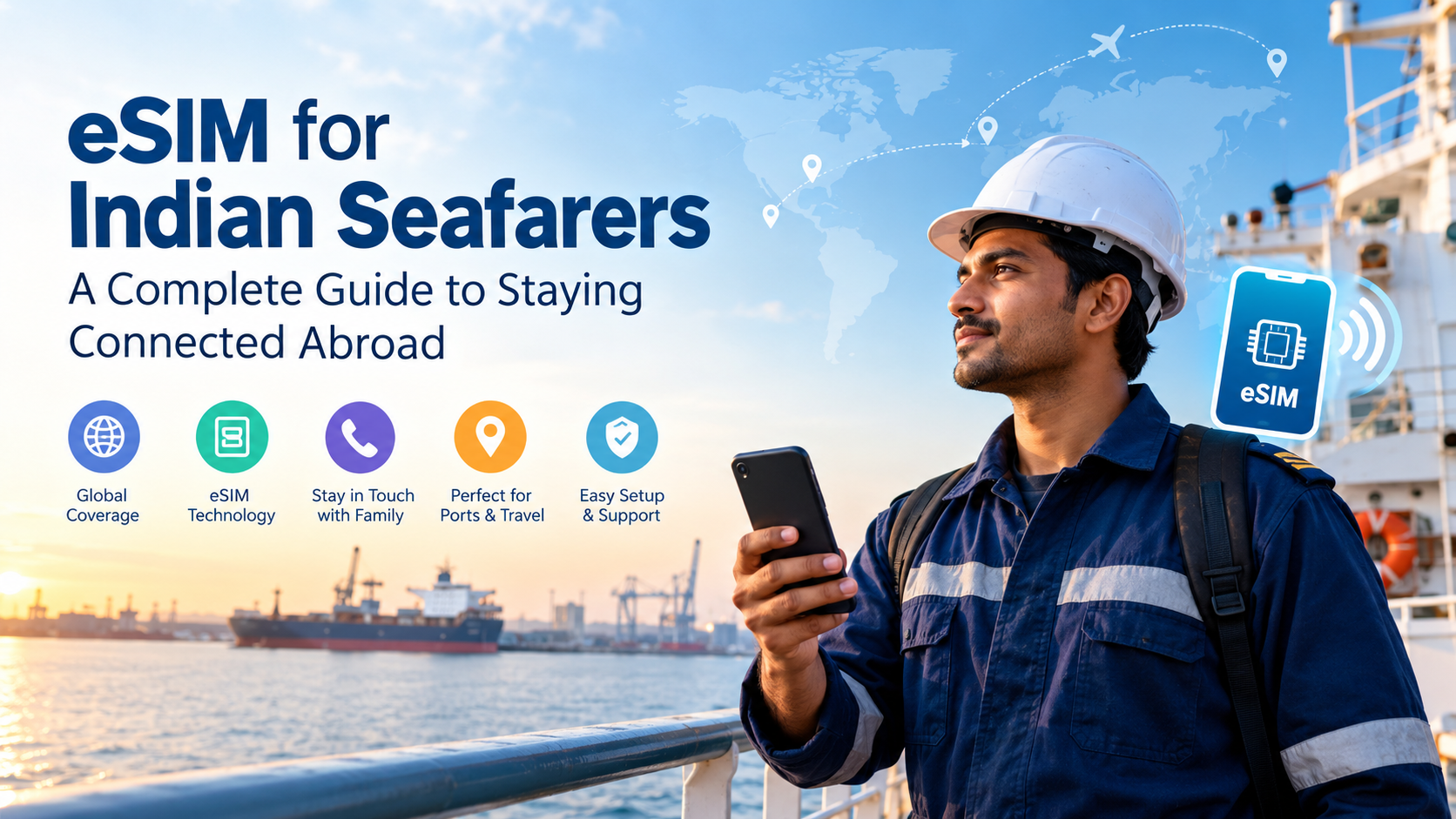
That is where an eSIM for Indian seafarers can make international travel easier.
What Is an eSIM for Indian Seafarers?
An eSIM is a digital SIM built into a compatible smartphone. Instead of inserting a physical SIM card, you purchase a mobile data plan and install the eSIM digitally.
For Indian seafarers, this can be particularly useful because international travel often involves multiple countries and short port stays.
Instead of:
- Searching for a SIM shop after reaching port
- Removing your Indian SIM card
- Carrying multiple physical SIM cards
- Paying expensive international roaming charges
- Repeating the process at every destination
you can install a suitable eSIM before travelling and use it when you reach a supported destination.
In simple terms, an eSIM for India seafarers is a convenient travel connectivity option for ports, coastal areas, airports, crew changes and international travel.
Can Indian Seafarers Use an eSIM?
Yes. Indian seafarers can use an eSIM if their smartphone supports eSIM technology and the selected plan covers their destination.
The important thing to understand is where an eSIM works.
A normal travel eSIM connects to terrestrial mobile networks. That means it can be useful when you are:
- At an international airport
- In a port city
- On shore leave
- Near the coast
- Travelling between ports
- Joining or leaving a vessel
- Staying in a hotel before or after a crew change
However, a standard eSIM should not be confused with satellite internet.
When your vessel is far offshore and outside the range of terrestrial mobile networks, your travel eSIM normally will not provide mobile data. For deep-sea connectivity, you may need the vessel’s Wi-Fi or satellite-based connectivity.
This distinction is important when choosing an eSIM for Indian Merchant Navy crew.
Why Indian Seafarers Need an eSIM
Indian seafarers often travel internationally for contracts, training, joining vessels and crew changes. Connectivity problems can become frustrating when you have limited time in a new country.
An eSIM can help in several practical situations.
1. Stay Connected During Crew Changes
Crew changes can involve flights, hotels, immigration, transport and short stays in unfamiliar cities.
Having mobile data available can help you access:
- Flight information
- Maps
- Hotel information
- Transport apps
- Crew-change instructions
- Online documents
You do not have to wait until you find a local SIM shop.
2. Keep Your Indian SIM Active
One of the biggest advantages of using an eSIM is that you can often keep your primary physical SIM in your phone while using the eSIM for travel data.
This can be useful for Indian seafarers who want to maintain access to their regular number while travelling internationally.
Your phone settings will determine exactly how dual-SIM and data switching work, so check your device before travelling.
3. Avoid Buying a New SIM at Every Port
Imagine visiting three countries during a crew rotation.
With physical SIM cards, you may need to find a shop, purchase a card, register it where required, install it and then repeat the process at the next destination.
An eSIM can reduce that hassle.
You can select a country, regional or global plan depending on your route and install it before you travel.
4. Use Data for Family Communication
For many Indian seafarers, staying in touch with family is one of the biggest reasons to maintain reliable connectivity.
Mobile data can be used for WhatsApp messages, voice calls, video calls and other communication apps whenever a supported mobile network is available.
This is especially useful during port calls and shore leave.
5. Access Banking and Important Apps
Indian seafarers may need mobile data to check banking apps, email, travel information and online services while abroad.
A reliable data connection can be useful when Wi-Fi is unavailable or unreliable.
Always remember that banking and OTP requirements can vary between services, so keeping your primary Indian number available may still be important.
What Is the Best eSIM for Indian Seafarers?
There is no single eSIM that is automatically best for every Indian seafarer.
The right choice depends on your route, destinations, trip duration and data usage.
Before buying an eSIM, consider these five things.
1. Destination Coverage
First, check where you are going.
If your journey involves only one country, a local eSIM may be enough.
If your vessel or travel route covers several countries in the same region, a regional eSIM may provide better flexibility.
For frequent international travel, a global eSIM can be more convenient.
2. Data Allowance
Think about how you actually use mobile data.
If you mainly use WhatsApp, email, maps and banking apps, you may not need a large data package.
If you regularly make video calls, upload files, use social media or stream videos, you will need considerably more data.
Buying the largest plan is not always the best decision. Choose based on your expected usage.
3. Validity Period
Look at how long the plan remains active.
A seafarer travelling for a short crew change may need only a few days of data.
Someone travelling between multiple countries or spending several weeks abroad may need a longer validity period.
4. Network Availability
Coverage is more important than simply seeing a long list of countries.
Check which networks the eSIM uses in your destination and whether coverage is available around the ports you are likely to visit.
5. Easy Activation
Seafarers do not always have time to troubleshoot complicated SIM installations.
Choose an eSIM with clear installation instructions and support if something goes wrong.
Ideally, install and prepare the eSIM before leaving India, while you still have reliable internet access.
Local, Regional or Global eSIM: Which Should Indian Seafarers Choose?
The easiest way to decide is to match the plan with your route.
| Your situation | Suitable option |
|---|---|
| Staying mainly in one country | Local eSIM |
| Visiting several countries in one region | Regional eSIM |
| Frequently changing countries | Global eSIM |
| Short airport or port visit | Small-data local plan |
| Long international trip | Regional or global plan |
For example, an Indian seafarer travelling to Germany for a crew change may only need a Germany eSIM.
But someone travelling through Germany, France, Italy and Spain could benefit from a regional Europe eSIM.
If the route changes frequently between Asia, Europe and the Middle East, a global plan may provide greater flexibility.
How Much Data Does an Indian Seafarer Need?
There is no universal answer because usage varies significantly.
As a basic guide:
Light usage:
Messaging, email, maps and occasional browsing.
Moderate usage:
Social media, regular voice calls, video calls and web browsing.
Heavy usage:
Frequent video calls, streaming, large downloads, social media uploads and hotspot use.
If your eSIM is mainly for port calls and travel days, you may need less data than someone using mobile data throughout an extended stay ashore.
A good approach is to start with a plan that matches your realistic usage rather than paying for excessive data.
Does an eSIM Work in the Middle of the Ocean?
Usually, no not a standard travel eSIM.
This is one of the most important points for seafarers.
A regular travel eSIM relies on terrestrial cellular networks. Once a vessel moves beyond the coverage of land-based mobile networks, the eSIM cannot simply connect to a mobile tower that is not there.
Therefore, an eSIM is best viewed as a port, coastal and international travel connectivity solution, rather than a replacement for satellite connectivity at sea.
For deep-sea communication, seafarers may need to use the vessel’s onboard internet or other maritime connectivity solutions.
This is why an eSIM can complement not replace the internet provided onboard.
When Should Indian Seafarers Install Their eSIM?
It is generally better to prepare your eSIM before you travel.
A practical process is:
Step 1: Check whether your phone supports eSIM.
Step 2: Check that your phone is unlocked and compatible with the selected plan.
Step 3: Choose a plan based on your destination and travel duration.
Step 4: Purchase the eSIM before departure.
Step 5: Install it while you have reliable Wi-Fi.
Step 6: Follow the provider’s activation instructions.
Step 7: Set the eSIM as your mobile-data line when you reach the supported destination.
This preparation can be especially useful when your crew-change schedule is tight.
eSIM vs Physical SIM for Indian Seafarers
Both options can work, but they have different advantages.
| Feature | eSIM | Physical SIM |
|---|---|---|
| Physical card required | No | Yes |
| Easy to install before travel | Yes | Usually no |
| Need to visit a SIM shop | Usually no | Often |
| Multiple plans | Easy to manage | More cumbersome |
| Keep primary SIM | Often possible | Requires dual-SIM setup |
| Useful for frequent international travel | Yes | Less convenient |
| Device compatibility | Required | Widely supported |
For a seafarer who regularly crosses borders, the convenience of an eSIM can be a major advantage.
What Indian Seafarers Should Check Before Buying an eSIM
Before purchasing, run through this checklist:
- Does my phone support eSIM?
- Is my phone network-unlocked?
- Does the plan cover my destination?
- Does it cover the ports on my route?
- How much data do I need?
- How long is the plan valid?
- When does validity begin?
- Can I install it before departure?
- Does it support hotspot/tethering if I need it?
- What happens if I need technical support?
- Do I still need my Indian SIM for calls or OTPs?
- Does my vessel provide separate onboard internet?
Taking five minutes to check these details can prevent connectivity problems later.
Why Mapians Can Be Useful for Indian Seafarers
For Indian seafarers who regularly travel internationally, Mapians provides eSIM options designed around international travel and multiple destinations.
You can choose from local, regional and global eSIM options depending on your route and connectivity needs.
Instead of buying a physical SIM every time you arrive in a new country, you can purchase an eSIM online and prepare your connection before travelling.
For seafarers, the biggest benefit is simple: less time searching for SIM cards and more flexibility when moving between countries.
Explore the Mapians eSIM for Seafarers options and choose a plan based on your destination.
Frequently Asked Questions About eSIM for Indian Seafarers
Can Indian seafarers use an eSIM?
Yes. Indian seafarers can use an eSIM if their smartphone supports eSIM technology and the selected plan provides coverage in their destination.
Which eSIM is best for Indian Merchant Navy crew?
The best option depends on the crew member’s route. A local eSIM can work well for one-country travel, while regional or global plans are more suitable for routes covering multiple countries.
Does an eSIM work while a ship is at sea?
A standard travel eSIM normally works only where compatible terrestrial mobile networks are available. It should not be considered a replacement for satellite or onboard ship connectivity during deep-sea voyages.
Can I keep my Indian SIM while using an eSIM?
Many compatible phones allow a physical SIM and eSIM to be used together. However, the exact dual-SIM functionality depends on the phone model and carrier.
Should I install my eSIM before leaving India?
Installing and preparing your eSIM before departure can be convenient because you can complete the setup while you have reliable Wi-Fi. Follow the provider’s instructions regarding when to activate the plan.
How much data does a seafarer need?
It depends on your usage. Messaging, email and maps require relatively little data, while video calls, streaming and large downloads can consume much more.
Can I use an eSIM during port calls?
Yes, provided the eSIM supports the country and there is compatible terrestrial network coverage in the port or surrounding area.
Final Thoughts
For Indian seafarers, international connectivity can be complicated because work often means crossing borders, changing vessels and spending limited time in ports.
An eSIM for Indian seafarers offers a simpler way to prepare for those journeys.
You can install your plan before travelling, avoid repeatedly searching for physical SIM cards and use mobile data in supported countries when you reach airports, ports, coastal areas and destinations.
The key is choosing the right plan for your actual route.
Check the countries you are visiting, estimate your data requirements, confirm device compatibility and understand where an eSIM will and will not work.
For deep-sea connectivity, keep using the appropriate onboard or satellite solution. For international travel and port connectivity, an eSIM can be a practical addition to your seafarer travel setup.
Planning your next crew change or international voyage? Explore Mapians eSIM plans and stay connected across supported destinations.