Table of Contents
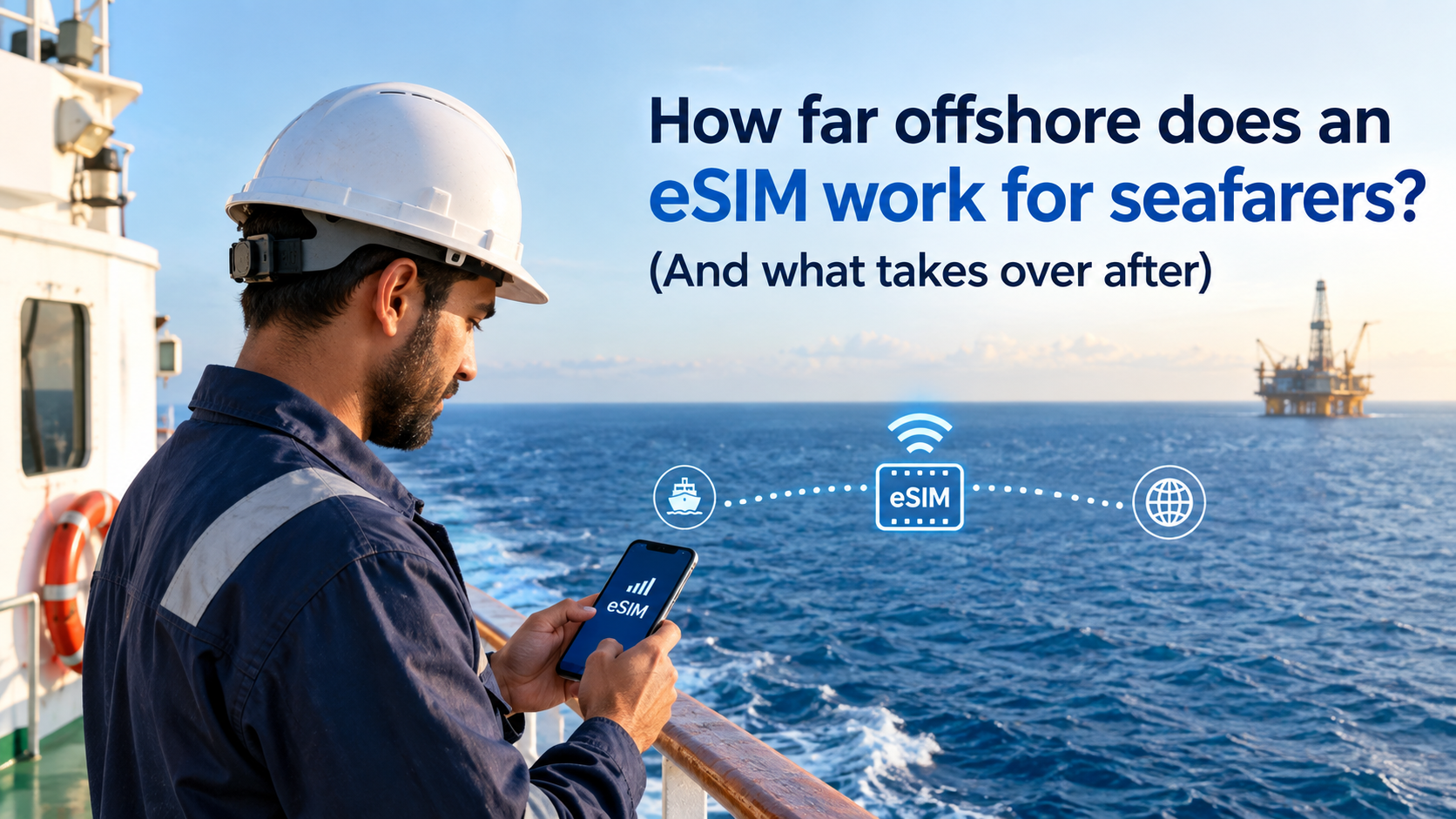
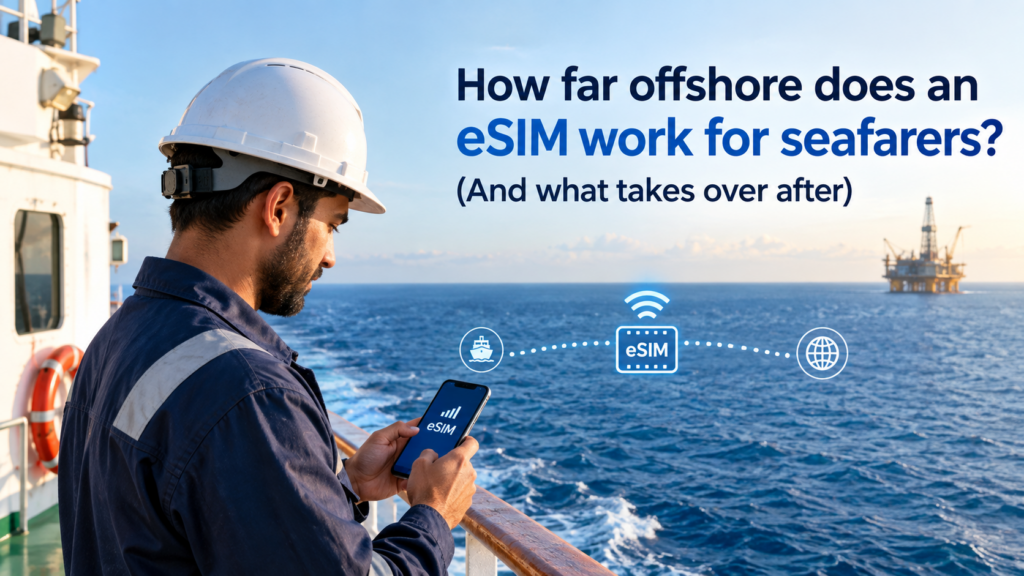
Short answer: An eSIM works exactly like a physical SIM it needs a cell tower. Most can expect reliable seafarers eSIM connectivity from about 10 to 50 kilometres offshore, depending on the coastline, the port’s network infrastructure, and how far out the local carrier’s towers reach. Once the ship clears that range, cellular signal eSIM or otherwise disappears completely. From that point, connectivity depends entirely on the vessel’s onboard satellite system: Starlink Maritime, Inmarsat NexusWave, or OneWeb.
If you’re planning connectivity for a voyage rather than a single port call, the real question isn’t “which eSIM is best” it’s “what covers the gap once my eSIM stops working.” This guide breaks that down.
Why an seafarers eSIM has a hard offshore limit
An seafarers eSIM isn’t a different technology from a physical SIM it’s the same cellular network access, just provisioned digitally. That means it inherits the same fundamental limitation: it needs a terrestrial cell tower in range.
Cell towers are built to serve land-based populations and coastlines, not open water. Signal can carry further over sea than over land because there are no buildings or hills blocking it, which is why coverage often extends further offshore than people expect but it still has a hard physical ceiling. Past that point, there’s no tower to connect to, full stop. No eSIM, no roaming agreement, and no amount of “global coverage” marketing changes that.
This is different from a coverage gap you might see on land, where a data plan is technically supported but slow. Offshore, past the range limit, the phone simply shows “No Service” the eSIM profile is still installed and valid, it just has nothing to connect to.
So how far offshore, exactly?
There’s no single number, because it depends on:
- Coastal topography — flat coastlines and calm water carry signal further than mountainous or obstructed coasts
- Tower density in that country — a well-developed port country (e.g. Singapore, the Netherlands) pushes coverage further out than a country with sparser rural infrastructure
- Vessel height and antenna setup — a large cargo ship’s bridge sits higher than a small craft, which can extend receivable range slightly
- Weather and atmospheric conditions — signal propagation varies day to day
As a planning rule of thumb, treat 10–20km as the point where you should expect signal to start degrading, and 50km as the outer edge where it’s essentially gone, even in favourable conditions. Anything beyond that is satellite territory.
What takes over once eSIM signal drops
Once a vessel is out of cellular range, connectivity shifts entirely to onboard satellite systems. The three most common on modern merchant and cruise vessels:
- Starlink Maritime — the fastest-growing option, using low-Earth-orbit satellites. Plans are typically sold in fixed data blocks (for example, a set GB allowance per billing cycle) with speeds that can exceed 100 Mbps in good conditions, though speeds throttle sharply once the data cap is hit.
- Inmarsat NexusWave — blends satellite (GX Ka-band), LEO broadband, and LTE where available into a single managed connection, aimed at giving crew a more consistent experience across the whole voyage rather than just in specific zones.
- OneWeb — another LEO constellation increasingly used for fleet-wide maritime broadband.
The practical difference for a seafarer: seafarers eSIM is personal, cheap, and fast in range; satellite is ship-managed, shared across the crew, and the only option once land infrastructure is out of reach. Neither replaces the other they cover different legs of the same voyage.
eSIM vs onboard satellite: quick comparison
| eSIM (cellular) | Ship satellite (Starlink / NexusWave / OneWeb) | |
|---|---|---|
| Range | ~10–50km from shore | Global, including open ocean |
| Speed | Fast where in range (local network speeds) | Varies; can exceed 100 Mbps but shared and often capped |
| Cost | Low, personal, pay-per-plan | Higher, usually shared crew allowance managed by the ship |
| Control | Individual your own data, your own device | Managed by the vessel operator |
| Best for | Port calls, coastal transits, shore leave | Open-ocean legs, long offshore stretches |
What this means for planning your connectivity
- Don’t rely on one solution for a full contract. An seafarers eSIM alone leaves you offline for the majority of most voyages; ship Wi-Fi alone is often slow, shared, and rationed.
- Buy your eSIM before you need it. Once you’re offshore, you can’t activate or top up do it in port or while you still have signal.
- Check what your ship actually has installed. Not every vessel has been upgraded to Starlink Maritime or NexusWave yet older VSAT systems are far slower and more heavily rationed across the crew.
- Treat eSIM as your “arrival window” tool the hours before docking and during shore leave are exactly when a personal eSIM matters most, since you’re back in tower range but don’t want to wait for the ship’s shared connection to catch up on calls home, banking, or messages.
Crew connectivity isn’t just a convenience question anymore the Maritime Labour Convention, 2006 (MLC 2006) recognises internet access as part of seafarer welfare, and industry surveys from bodies like the International Transport Workers’ Federation consistently rank staying in touch with family among the top concerns for crew on long contracts. Planning around the eSIM-to-satellite handoff, rather than assuming one covers the whole voyage, is the difference between being reachable and being cut off for weeks at a time.
Cargo crew vs cruise crew: does this change anything?
The offshore cutoff itself doesn’t change by ship type physics is physics. But the practical impact differs:
- Cargo and tanker crew typically have longer open-ocean legs between ports and older, more heavily rationed VSAT systems, so the eSIM window (in port and on the coastal approach) is often the only fast, unrationed connectivity they get for days at a stretch.
- Cruise crew and passengers are more likely to be on a Starlink-equipped vessel already, which narrows the gap but shared bandwidth across hundreds of passengers still makes a personal eSIM worthwhile for anything time-sensitive during port days.
Either way, the planning principle is the same: know your ship’s satellite setup before you rely on it, and treat the seafarers eSIM as covering the legs satellite doesn’t do well.
FAQs about seafarers eSIM
Does an eSIM work in the middle of the ocean?
No. An eSIM connects to the same cellular towers a physical SIM would, and those towers don’t exist in open water. Once you’re out of range of land-based infrastructure, an seafarers eSIM has nothing to connect to, regardless of the plan or provider.
How do I know when my eSIM will stop working?
Watch your signal bars as the ship moves away from port they’ll drop off within the first hour or two of departure on most routes. There’s no in-app warning; the connection simply degrades and then disappears.
If my ship has Starlink, do I still need an eSIM?
Yes, for most crew. Starlink and similar systems are shared across the whole ship and often rationed. A personal eSIM gives you fast, private data in port and coastal waters without competing for the ship’s bandwidth.
Does seafarers eSIM range vary by country?
Yes. Countries with denser coastal infrastructure (parts of Europe, Singapore, the UAE) tend to hold signal further offshore than countries with sparser rural networks.
Is ship Wi-Fi the same as an eSIM?
No. Ship Wi-Fi is the vessel’s shared satellite connection, distributed to crew and passengers over local Wi-Fi and managed by the operator. An seafarers eSIM is a personal cellular data plan on your own device, independent of the ship, and only works within cellular range of shore.
Conclusion
An seafarers eSIM covers seafarers well in port and along the coast typically out to somewhere between 10 and 50 kilometres and then hands off completely to whatever satellite system the ship carries. Planning connectivity around that handoff, rather than expecting either tool to do the whole job, is what actually keeps you reachable across a full voyage.