Table of Contents
Planning a trip around Europe? Staying connected is almost as important as booking your flights and accommodation.
You’ll likely need mobile data for Google Maps, WhatsApp, train tickets, hotel bookings, translation apps, email and travel research.
Traditionally, travelers bought a physical SIM after arriving at their destination. Today, an eSIM provides another option that can be arranged before you leave home.
So, which is better: Orange eSIM or a local SIM in Europe?
The answer depends on your trip.
For short holidays and multi-country journeys, an Orange eSIM can offer greater convenience. For long stays in one country or travelers who need a local phone number, a local SIM may be more suitable.
Let’s compare both options.
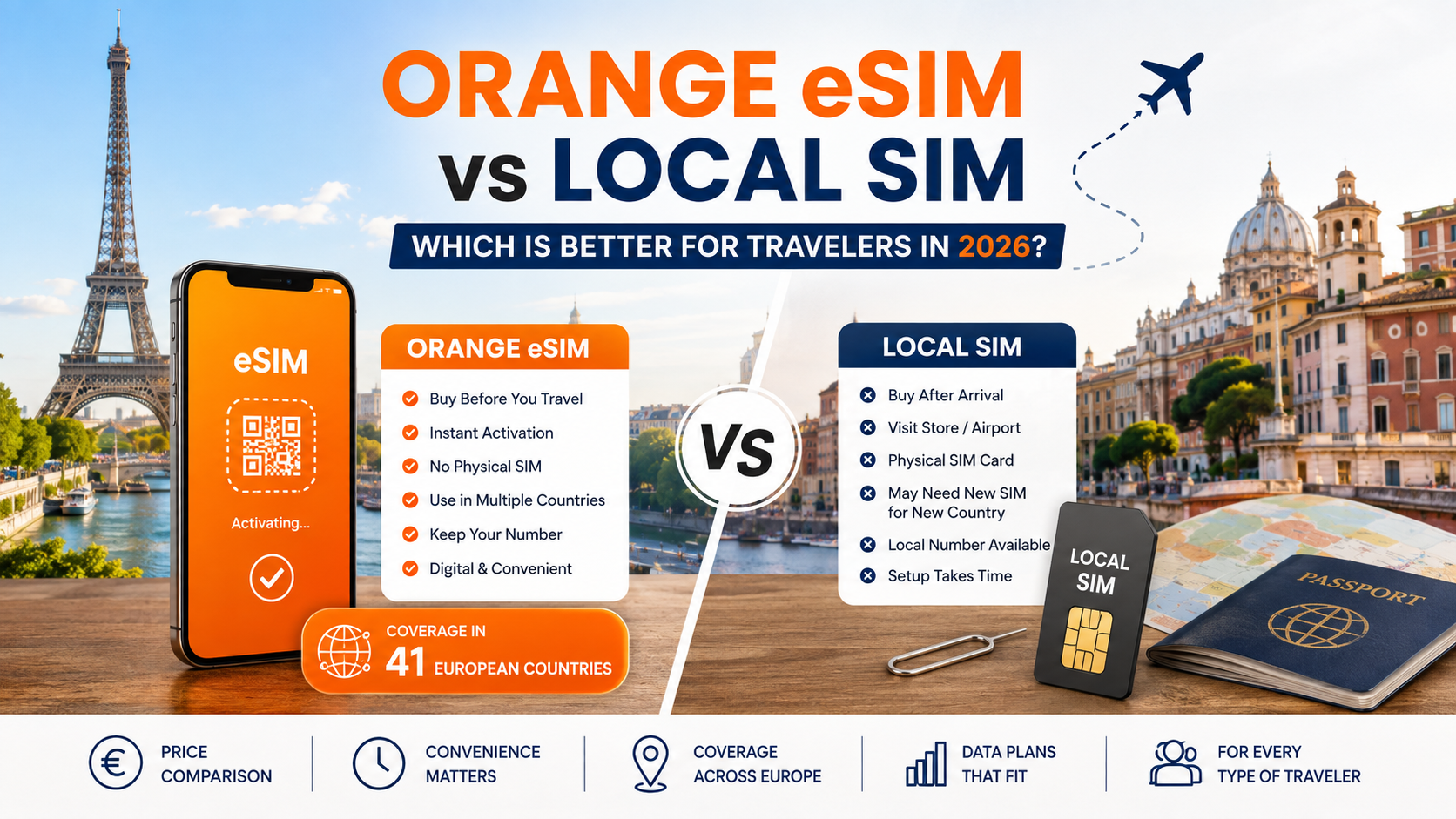
Orange eSIM vs Local SIM at a Glance
| Feature | Orange eSIM | Local SIM |
|---|---|---|
| Physical card required | No | Yes |
| Buy before departure | Yes | Usually after arrival |
| Installation | Digital | Physical |
| Multi-country travel | Convenient with supported regional plan | May require separate SIMs |
| Keep your existing SIM | Possible on compatible phones | Usually requires switching SIM |
| Local phone number | Depends on plan | Commonly available |
| Setup before flying | Yes | Usually no |
| Visit a physical store | Not normally required | Usually required |
| Best for | Short & multi-country trips | Long single-country stays |
Neither option is automatically the winner. The right choice depends on your itinerary, budget and connectivity needs.
What Is an Orange eSIM?
An eSIM is a digital SIM profile that can be installed on a compatible smartphone without inserting a physical SIM card.
Instead of waiting until you arrive in Europe to find a mobile store, you can purchase your travel plan online and install the eSIM before your trip.
Mapians currently lists Orange Holiday Europe plans with different data allowances and validity periods. The listed Europe plans provide coverage across 41 countries.
This makes a regional eSIM particularly useful for travelers visiting multiple supported European destinations.
For example:
France → Switzerland → Italy → Germany
Instead of purchasing a new SIM in each destination, a suitable regional eSIM can simplify your connectivity throughout the journey.
What Is a Local SIM?
A local SIM is a physical SIM card purchased from a mobile operator or retailer in the country you’re visiting.
You might purchase one:
- At an airport
- From a mobile network store
- At a shopping center
- From an authorized retailer
- Through a local provider
After purchasing the SIM, you’ll usually need to insert it into your phone and complete the activation process.
A local SIM can be useful if you’re staying in one country for an extended period or need a local mobile number.
1. Which Is Easier to Set Up?
Orange eSIM
With an eSIM, the process is digital:
Choose plan → Purchase → Receive eSIM details → Install → Connect
Mapians provides digital delivery and installation instructions for its Orange eSIM plans.
You can prepare the eSIM before leaving home, preferably while connected to reliable Wi-Fi.
Local SIM
With a physical SIM, you generally need to:
Find a store → Buy SIM → Insert SIM → Activate → Configure
This isn’t necessarily difficult, but it takes more time after arrival.
Winner: Orange eSIM
If convenience is your priority, an eSIM has the advantage.
2. Which Is Better for Multi-Country Europe Travel?
This is where the difference becomes more important.
Imagine your itinerary includes:
France → Belgium → Netherlands → Germany → Italy
Buying a separate SIM for every country can be inconvenient.
A regional Europe eSIM allows you to use one travel plan across supported destinations.
The Orange Europe plans currently listed by Mapians cover 41 countries, subject to the plan’s supported destinations.
A local SIM, on the other hand, is generally designed around a particular country’s network and plan.
Winner: Orange eSIM
For multi-country trips, a regional eSIM can be much simpler.
3. Orange eSIM vs Local SIM: Which Is Cheaper?
There isn’t a universal answer.
A local SIM may be cheaper in some countries, particularly if you’re staying for a long time.
But you should also consider the hidden cost of convenience.
With a local SIM, you may spend time:
- Finding a retailer
- Comparing local packages
- Waiting in line
- Activating the card
- Changing SIM cards
- Repeating the process in another country
The current Orange Europe options listed by Mapians are:
| Data | Validity | Price |
|---|---|---|
| 1GB | 7 days | £3.49 |
| 4GB | 31 days | £4.99 |
| 20GB | 31 days | £11.99 |
| 50GB | 31 days | £24.99 |
| 100GB | 31 days | £29.99 |
| 200GB | 31 days | £44.99 |
| 500GB | 90 days | £84.99 |
These are the prices currently shown on the Mapians product page and may change. Check the live offer before purchasing.
Winner: Depends
Short trip + multiple countries: Orange eSIM may provide better overall convenience.
Long stay + one country: A local SIM may be worth comparing.
4. What About Keeping Your Normal Phone Number?
This is an important advantage of eSIM technology.
If your phone supports Dual SIM functionality, you may be able to keep your regular SIM while using the travel eSIM.
For example:
Regular SIM: Your normal number
Orange eSIM: Travel data
This means you don’t necessarily have to remove your regular SIM from the phone.
With a physical local SIM, you usually need to replace your existing SIM or use another SIM slot if your phone supports one.
Winner: Orange eSIM
For travelers who want to keep their normal SIM available, an eSIM can be more flexible.
5. What If You Need a Local Phone Number?
This is one situation where a local SIM can have an advantage.
Some travelers need a local number for:
- Local calls
- SMS
- Reservations
- Local services
- Business communication
Whether an eSIM provides traditional calls or SMS depends on the specific plan.
If having a local phone number is essential, check the individual plan details before purchasing.
Winner: Local SIM
For travelers specifically looking for a local number, a traditional local SIM may be more appropriate.
6. Which Is Better for a Short Europe Trip?
Suppose you’re traveling for seven days.
Your itinerary:
Paris → Amsterdam → Berlin
You don’t want to spend part of your holiday looking for SIM shops.
A travel eSIM can be purchased before departure and prepared ahead of time.
The current Mapians Orange range includes a 1GB plan with 7 days of validity for £3.49.
For light data usage, that can be an option worth considering.
Best choice: Orange eSIM
7. Which Is Better for a Long Stay?
Now consider a different situation.
You’re staying in Spain for three months.
You don’t plan to visit other countries and need a local number for everyday communication.
In this situation, a local Spanish SIM may be worth researching.
A local provider could offer country-specific long-term packages that better match your requirements.
Best choice: Compare local SIM options
An eSIM isn’t automatically the best solution for every travel scenario.
8. Which Is Better for Backpackers?
Backpackers often visit several countries during one trip.
For example:
Spain → France → Belgium → Netherlands → Germany → Czech Republic → Austria → Italy
Convenience becomes extremely important.
A regional eSIM means you don’t have to repeatedly search for SIM cards during your journey, as long as your destinations are included in the plan.
Best choice: Orange eSIM
For supported multi-country itineraries, an eSIM can reduce the hassle of managing connectivity.
9. Which Is Better for Digital Nomads?
Digital nomads have different requirements from ordinary tourists.
You may need mobile data for:
- Zoom or Google Meet
- Slack
- Cloud storage
- Content uploads
- Navigation
- Hotspot use
- Online payments
A larger data plan may therefore be more appropriate.
The Mapians Orange Europe range includes options up to 500GB with 90 days of validity.
However, heavy users should check the specific plan conditions before relying on an eSIM as their primary internet connection.
Best choice: Depends
Multi-country nomad: Orange eSIM can be convenient.
Long-term nomad in one country: Compare local SIM options.
10. Which Is Better for Families?
Families have to consider another factor: multiple devices.
If four family members each use mobile data, one plan may not be enough.
Before purchasing, calculate:
Number of users × expected daily data × number of travel days
For families who primarily use hotel Wi-Fi, smaller data packages may be sufficient.
Families who frequently use video, social media and navigation may need significantly more data.
Best approach
Compare the total cost of multiple eSIMs against local family or multi-line SIM packages.
Orange eSIM Europe: Current Plan Options
If you’re considering an Orange eSIM, the current Mapians Europe selection includes:
- 1GB — £3.49
- 4GB — £4.99
- 20GB — £11.99
- 50GB — £24.99
- 100GB — £29.99
- 200GB — £44.99
- 500GB — £84.99
The listed Europe plans provide 41-country coverage, with validity ranging from 7 to 90 days depending on the plan.
The best plan isn’t necessarily the largest one. Choose according to your expected data usage and travel duration.
Advantages of Orange eSIM
No physical SIM card
Everything is handled digitally.
Prepare before departure
You don’t have to wait until you arrive to organize your mobile data.
Useful for multi-country travel
One regional plan can be more convenient than managing several physical SIMs.
Keep your regular SIM
Compatible phones may allow you to keep your normal SIM alongside the eSIM.
Multiple data options
Travelers can select different data allowances according to their needs.
Advantages of a Local SIM
Local number
A local SIM can be useful when local calls or SMS are important.
Country-specific packages
Local operators may offer attractive packages for longer stays.
Useful for long-term travel
If you’re spending months in one country, a local plan may provide better value.
Widely supported
Physical SIMs work with phones that have a compatible SIM slot, even if they don’t support eSIM.
Orange eSIM vs Local SIM: The Final Decision
Here’s the simplest way to decide:
| Your situation | Better option |
|---|---|
| 3–7 day European holiday | Orange eSIM |
| Multi-country Europe trip | Orange eSIM |
| Backpacking across Europe | Orange eSIM |
| Business trip across several countries | Orange eSIM |
| Digital nomad moving between countries | Orange eSIM |
| Long stay in one country | Compare local SIM |
| Need a local phone number | Local SIM |
| Phone doesn’t support eSIM | Local SIM |
| Want to prepare connectivity before flying | Orange eSIM |
Final Verdict: Orange eSIM or Local SIM?
There is no single answer for every traveler.
Choose Orange eSIM if your priority is convenience, digital setup and connectivity across multiple supported European destinations.
Choose a local SIM if you’re staying in one country for a long period, need a local number or find a country-specific package that better suits your needs.
For most tourists taking a short, multi-country Europe trip, the convenience of an eSIM can make it the more practical choice.
Before purchasing, check your phone compatibility, destination coverage, data allowance and plan validity.
Frequently Asked Questions
Is Orange eSIM better than a local SIM in Europe?
For short and multi-country trips, Orange eSIM can be more convenient because you can arrange connectivity before departure. A local SIM can be better for long stays or when a local phone number is required.
Is Orange eSIM expensive?
The current Mapians Orange Europe plans start at £3.49 and range up to £84.99, depending on data and validity.
Can I use Orange eSIM in multiple European countries?
The Orange Holiday Europe plans listed on Mapians cover 41 countries. Check the supported-country list for your specific plan before purchase.
Can I keep my physical SIM when using Orange eSIM?
On compatible Dual SIM devices, you may be able to keep your physical SIM while using the eSIM for travel data.
Is a local SIM cheaper than an eSIM?
It can be, especially for long stays in one country. However, prices vary by country, provider, data allowance and duration.
Should I buy an eSIM before traveling to Europe?
Buying before departure can be convenient because you can arrange your connectivity while you still have reliable Wi-Fi.
What is the cheapest Orange Europe eSIM?
The current Mapians listing shows a 1GB plan for £3.49, with 7 days of validity.
Do I need an unlocked phone?
Your device needs to support the relevant eSIM/network configuration. Check your phone’s compatibility and network-lock status before purchase.