Table of Contents
Best eSIM for Seafarers in 2026: Compare Maritime eSIM Plans
Finding the best eSIM for seafarers depends on more than price. Your sailing route, next port, mobile data usage, plan validity, network availability and the number of countries you expect to visit all matter when choosing a maritime eSIM.
A crew member making a short port call in Singapore may need a different plan from a Merchant Navy officer travelling through Europe, the Middle East and Asia during a longer contract.
In this guide, we compare maritime eSIM plans for seafarers, including country, regional and global eSIM options. You’ll learn how to choose the right plan for your route, how much data you may need, what to check before buying and how an eSIM compares with physical SIM cards, roaming and satellite connectivity.
Important: A standard cellular eSIM connects to supported terrestrial mobile networks. It does not replace a vessel’s satellite communication system when the ship is outside cellular coverage.
Quick Answer: What Is the Best eSIM for Seafarers?
The best eSIM for seafarers depends mainly on the number of countries you expect to visit.
- One country: Choose a country-specific eSIM.
- Several countries in one region: A regional eSIM can be more convenient.
- Multiple regions: Consider a global eSIM.
- Short port calls: A smaller data plan may be sufficient.
- Heavy data users: Consider larger-data or unlimited options after checking high-speed limits, fair-use policies and hotspot restrictions.
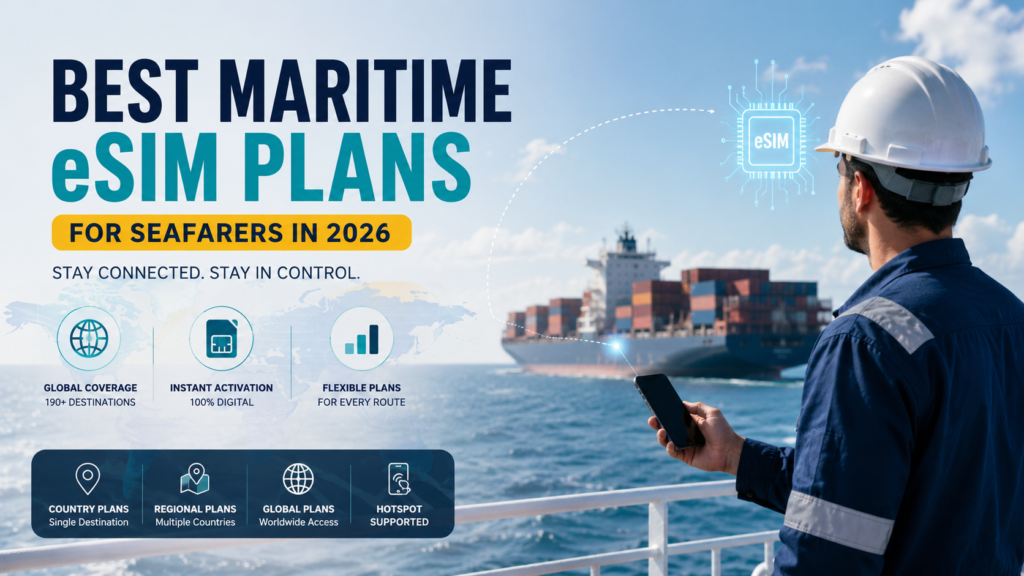
Mapians offers local, regional and global eSIM options across 190+ destinations, allowing seafarers to choose connectivity based on their destination and travel requirements.
Best eSIM for Seafarers at a Glance
| eSIM Type | Best For | Main Benefit | Potential Limitation |
|---|---|---|---|
| Country eSIM | One destination | Focused coverage | Limited to selected destination |
| Regional eSIM | Several countries in one region | Convenient multi-country coverage | Some countries may be excluded |
| Global eSIM | Multiple regions | Greater flexibility | May cost more than a country plan |
| Large-data eSIM | Heavy users | More data for calls and online activity | Check fair-use and hotspot terms |
Ready to check your next destination? Explore Mapians eSIM plans and compare available options before your next port call.
How We Compare Maritime eSIM Plans
The cheapest eSIM is not automatically the best eSIM for a seafarer.
Before buying a maritime eSIM plan, compare:
- Destination coverage
- Supported mobile networks
- Data allowance
- Plan validity
- Price
- Cost per GB
- Hotspot availability
- Activation requirements
- Top-up options
- Smartphone compatibility
A plan that costs less but does not cover your next port may provide less value than a slightly more expensive plan that matches your voyage.
1. Best Country eSIM for Seafarers
A country-specific eSIM is a good option when your voyage or port schedule is concentrated in one destination.
For example, if you know that your vessel will make a port call in Singapore, Japan, India or the United Kingdom, a country eSIM may be more practical than purchasing a broad global package.
A country eSIM is best for:
- Seafarers visiting one main destination
- Short port calls
- Predictable routes
- Users who want to control spending
- Travellers who only need connectivity in one country
The main advantage is simple: you pay for coverage that matches the destination you actually need.
Mapians provides country-specific eSIM options for destinations around the world. Available data, validity, network support and pricing can vary by destination, so always check the current plan details before purchasing.
2. Best Regional eSIM for Seafarers
A regional eSIM can be a better choice when your route includes several countries in the same region.
For example, a seafarer travelling between multiple European ports may prefer a Europe regional eSIM instead of purchasing a separate country eSIM for every destination.
A regional plan can be useful when:
- Your vessel visits several countries
- Your route changes between nearby destinations
- You want one eSIM for multiple countries
- You expect several port calls during the plan’s validity
However, don’t assume that every country in a region is automatically included.
Always check the actual country list before buying.
If an important port is excluded, a country-specific plan may be a better option.
3. Best Global eSIM for Seafarers
A global eSIM for seafarers can be useful when your route crosses multiple regions.
Merchant Navy crew and other maritime workers may travel through different countries during a contract. A global plan can reduce the need to repeatedly purchase separate country plans.
A global eSIM may suit you if:
- Your itinerary crosses continents
- You visit several countries
- Your route can change during your contract
- You want one digital connectivity solution
- You prefer preparing your connectivity before departure
However, global eSIM does not mean global cellular coverage.
A standard cellular eSIM still depends on compatible terrestrial mobile networks. Always check the provider’s destination list and the specific plan conditions.
Mapians offers global eSIM options covering 190+ destinations alongside local and regional plans.
4. Best eSIM for Seafarers During Port Calls
Port calls create a unique connectivity requirement.
You may only have a few hours ashore, making it inconvenient to spend valuable shore leave searching for a physical SIM card.
An eSIM for port calls can be useful because connectivity can be prepared digitally before you reach your destination, where the plan and device support the local cellular network.
For a short port call, consider:
- Destination coverage
- Short plan validity
- Enough data for essential tasks
- Digital activation
- Supported local networks
During shore leave, many seafarers mainly need mobile data for:
- Google Maps
- Banking
- Transport apps
- Browsing
- Social media
If this sounds like your usage pattern, a very large data package may not always provide the best value.
The goal is to buy enough usable data for your port call without paying for unnecessary capacity.
5. Best eSIM for Heavy Data Users
Some seafarers need significantly more mobile data.
You may need a larger eSIM plan if you regularly:
- Make video calls
- Watch online videos
- Use social media heavily
- Upload files
- Stream content
- Use your phone as a hotspot
- Connect a laptop or tablet
Before purchasing a high-data or unlimited eSIM plan, check:
- High-speed data allowance
- Fair-use policy
- Hotspot restrictions
- Plan validity
- Network availability
- Streaming restrictions
- Tethering conditions
Don’t choose a plan simply because it says “unlimited.”
The actual terms determine how much high-speed data you can use and whether hotspot or tethering is supported.
6. Best eSIM for Merchant Navy Crew
A Merchant Navy eSIM can be useful for crew members whose work involves frequent international travel.
Unlike a normal traveller who may visit one destination, a seafarer’s itinerary can include several countries during one contract.
Depending on the route, a crew member may need:
- A country eSIM for one port
- A regional eSIM for several nearby countries
- A global eSIM for a multi-region route
The right choice depends on the ports you expect to visit and the duration of your connectivity needs.
For example:
One destination → Country eSIM
Several European ports → Regional eSIM
Europe + Asia + Middle East → Global eSIM
Always verify that your next destination is included before purchasing.
Country vs Regional vs Global eSIM for Seafarers
The easiest way to compare the main maritime eSIM options is to look at your sailing route.
| Plan Type | Best For | Coverage | Main Advantage |
|---|---|---|---|
| Country eSIM | One destination | Single country | Focused and potentially economical |
| Regional eSIM | Several countries | One region | Convenient for multi-country routes |
| Global eSIM | Multiple regions | Multiple destinations | Greater flexibility |
There is no universally best eSIM plan for every seafarer.
If your vessel makes one major port call, a country eSIM may be enough.
If your route includes several European destinations, a regional eSIM may be more convenient.
If your contract takes you through Asia, Europe, the Middle East and other regions, a global eSIM may offer greater flexibility.
How Much Does a Maritime eSIM Cost?
There is no single maritime eSIM price because eSIM costs vary by destination, data allowance, validity and plan type.
Instead of comparing only the advertised price, consider the total value of the plan.
Cost per GB
Cost per GB = Plan price ÷ Included data
Cost per day
Cost per day = Plan price ÷ Validity period
For example:
Plan A
- 5 GB
- 15 days
- £8
Plan B
- 10 GB
- 30 days
- £14
Plan A has the lower total price.
Plan B provides twice the data and twice the validity and may therefore offer better value for someone who needs connectivity for an entire month.
However, price should never be considered separately from coverage.
A cheap plan that doesn’t support your next port is not necessarily a good deal.
How Much Data Does a Seafarer Need?
Your data requirement depends on how you use your phone and how much reliable Wi-Fi is available onboard.
Light data user
If you mainly use:
- WhatsApp messages
- Basic browsing
A smaller plan may be enough.
Moderate data user
If you regularly use:
- Maps
- Banking
- Social media
- Browsing
- Music
Consider a moderate data allowance.
Heavy data user
If you frequently use:
- Video calls
- Streaming
- Hotspot
- Large file uploads
A larger data plan may be more suitable.
The best approach is to consider your actual usage rather than automatically purchasing the biggest available package.
eSIM vs Physical SIM for Seafarers
For international seafarers, an eSIM can offer convenience compared with purchasing a physical SIM at every destination.
| Feature | eSIM | Physical SIM |
|---|---|---|
| Physical card required | No | Yes |
| Digital installation | Yes | No |
| Change plans digitally | Often easier | Requires SIM replacement in many cases |
| Risk of losing card | Lower | Higher |
| Multiple plans | Device dependent | Usually requires swapping SIMs |
| Device requirement | eSIM-compatible phone | Compatible SIM slot |
An eSIM is particularly convenient when your itinerary includes multiple supported destinations.
However, your phone must support eSIM and may need to be carrier-unlocked.
eSIM vs International Roaming for Seafarers
International roaming can be convenient, but charges and allowances depend on your mobile operator and roaming package.
A travel eSIM can provide another option for supported destinations.
Before choosing between roaming and an eSIM, compare:
- Destination coverage
- Data allowance
- Price
- Validity
- Network support
- Activation requirements
- Hotspot availability
For frequent international travellers, comparing these factors before departure can make mobile connectivity easier to manage.
What Makes a Maritime eSIM Good Value?
A good-value eSIM should balance:
Coverage + usable data + validity + network access + price
Your best option depends on how you travel.
If you mainly use WhatsApp and email
A smaller package may be sufficient.
If you use maps and banking during shore leave
A moderate package may be enough.
If you make frequent video calls
Consider a larger data allowance.
If you use hotspot
Check whether tethering is supported.
If you visit multiple countries
Compare regional and global plans instead of automatically purchasing several country-specific plans.
7 Questions to Ask Before Buying an eSIM for Seafarers
1. Does the eSIM cover my next port?
Check the exact destination list before purchasing.
2. Which network will the eSIM use?
Network availability can vary by country and plan.
3. How much data do I need?
Estimate your actual usage instead of automatically choosing the largest plan.
4. When does the eSIM validity begin?
Depending on the plan, validity may begin at activation or when the eSIM connects to a supported network. Always read the specific plan conditions.
5. Can I use hotspot?
If you need to connect a laptop, tablet or another device, confirm that tethering is supported.
6. Can I top up the eSIM?
A top-up option can be useful if you run out of data before your next port.
7. Is my phone compatible?
Your smartphone must support eSIM technology. Carrier-unlock requirements may also apply.
How to Choose the Best eSIM for Your Voyage
Instead of immediately buying the cheapest plan, follow these five steps.
Step 1: List Your Next Destinations
Write down the countries and ports you expect to visit.
Step 2: Estimate Your Mobile Data Usage
Decide whether you are a light, moderate or heavy data user.
Step 3: Compare eSIM Types
Compare:
- Country eSIM
- Regional eSIM
- Global eSIM
Step 4: Compare the Complete Value
Look at:
- Price
- Data
- Validity
- Coverage
- Networks
- Hotspot support
Step 5: Prepare Before Your Port Call
Where the provider’s instructions allow it, install and prepare your eSIM before you need cellular connectivity.
Preparing in advance can save time during a short port call.
Why Choose Mapians for Seafarer Connectivity?
Mapians provides local, regional and global eSIM plans across 190+ destinations, giving international travellers and seafarers different options based on their routes.
Instead of relying on one plan for every journey, you can select an eSIM based on your destination and expected requirements.
Mapians also provides digital eSIM purchasing, activation and data management through its platform and app.
For seafarers, this flexibility can be useful because sailing routes and port schedules can vary.
Always check the current destination coverage, pricing, supported networks, data allowance and validity before purchasing.
Maritime eSIM vs Satellite Connectivity
A maritime eSIM and satellite connectivity serve different purposes.
A standard cellular eSIM connects through compatible terrestrial mobile networks.
When your vessel moves beyond terrestrial cellular coverage, a normal travel eSIM cannot provide the same connectivity as a satellite communication system.
In simple terms:
eSIM → Mobile connectivity in supported ports and coastal cellular coverage
Satellite connectivity → Offshore communication where terrestrial networks are unavailable
Therefore, a maritime eSIM should not be considered a replacement for onboard satellite communication.
Frequently Asked Questions
What is the best eSIM for seafarers?
The best eSIM for seafarers depends on your sailing route, destinations, data usage and budget. A country eSIM is suitable for one destination, a regional eSIM works well for several countries in one region, and a global eSIM can be useful for multi-region travel.
Is a global eSIM better than a regional eSIM?
Not necessarily. A global eSIM provides broader flexibility, while a regional eSIM may offer better value when your route remains within one region.
What is the cheapest eSIM for seafarers?
There is no single cheapest eSIM for every seafarer. Prices vary according to destination, data allowance, validity and coverage. Compare the complete plan rather than choosing only by the lowest advertised price.
How much data should a seafarer buy?
Light users who mainly use messaging and email may need less data. Users who regularly make video calls, stream content or use hotspot may need a larger plan. Your onboard Wi-Fi availability should also be considered.
Can seafarers use an eSIM during a port call?
Yes. A seafarer can use an eSIM during a port call when the plan supports the destination and the phone can connect to a compatible terrestrial mobile network.
Can seafarers use an eSIM at sea?
A standard travel eSIM depends on terrestrial cellular networks. It generally cannot provide normal cellular service in areas where compatible mobile networks are unavailable.
Does a global eSIM work in the middle of the ocean?
A standard global eSIM does not provide satellite connectivity. It should not be treated as a replacement for onboard satellite communications when a vessel is offshore and outside terrestrial cellular coverage.
Can I use hotspot with a seafarer eSIM?
It depends on the specific plan. If you need to connect a laptop, tablet or another device, check the plan’s hotspot or tethering conditions before purchasing.
Is eSIM better than roaming for seafarers?
It depends on your destination, mobile usage and roaming plan. Compare coverage, data, price, validity, network support and hotspot availability before choosing.
Can Merchant Navy crew use an eSIM?
Yes, provided the crew member’s smartphone supports eSIM and the selected plan supports the destination and required mobile network.
Final Verdict: What Is the Best eSIM for Seafarers?
The best eSIM for seafarers in 2026 is not necessarily the cheapest plan or the one offering the most data.
Choose according to your sailing route:
One country → Country eSIM
Several countries in one region → Regional eSIM
Multiple regions → Global eSIM
Then compare:
- Destination coverage
- Network availability
- Data allowance
- Validity
- Price
- Hotspot support
- Top-up options
For seafarers, one of the biggest advantages of an eSIM is convenience. You can prepare your mobile connectivity digitally and avoid relying on a new physical SIM every time your vessel reaches a supported destination.
Mapians offers local, regional and global eSIM options across 190+ destinations, giving seafarers flexibility to choose connectivity based on their route.
Before buying, always check your destination, plan validity, network support, device compatibility and current pricing.
Ready to Stay Connected at Your Next Port?
Choose a country, regional or global eSIM based on your sailing route, data requirements and destination.
Explore Mapians eSIM Plans
Not sure which plan is right for you?
Check your next destination first and compare the available eSIM options.