Table of Contents
Staying connected is an important part of life at sea. Seafarers need internet to communicate with family, check messages, use banking apps, access maps, manage travel arrangements and stay connected during port calls.
But choosing the right connectivity option can be confusing.
Should you use your regular mobile roaming? Buy a personal eSIM? Pay for ship Wi-Fi? Or use a combination of different options?
The answer depends largely on where your vessel is located.
A standard travel eSIM generally connects to land-based mobile networks, so it is most useful in ports and coastal areas. Once a vessel moves beyond cellular coverage, a normal travel eSIM cannot replace the ship’s satellite-based internet connection. Ship Wi-Fi, on the other hand, can provide connectivity offshore because it relies on the vessel’s satellite connection.
For many seafarers, the most cost-effective approach is not choosing just one option. It is using an eSIM for port and coastal connectivity and ship Wi-Fi when offshore, while keeping standard mobile roaming disabled unless specifically required.
Which Is Cheapest for Seafarers?
For most seafarers:
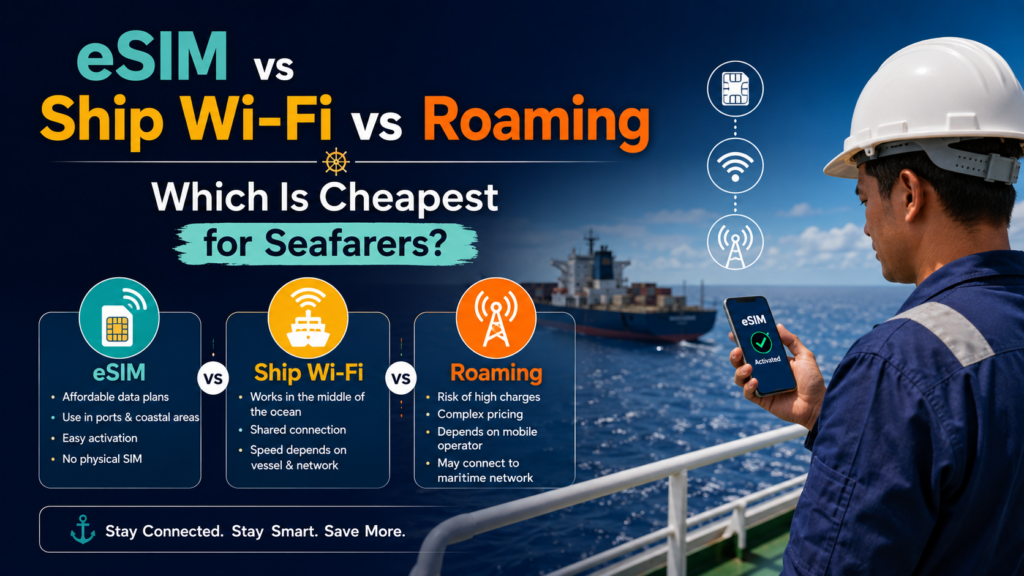
- eSIM: Usually the better-value option for port calls and coastal connectivity.
- Ship Wi-Fi: Usually the practical option when the vessel is offshore.
- Regular roaming: Often the riskiest option because maritime roaming charges can become expensive if your phone automatically connects to an onboard network.
A personal eSIM and ship Wi-Fi therefore solve different connectivity problems rather than being direct replacements for each other.
Recent maritime connectivity guidance similarly recommends using an eSIM near ports and relying on onboard satellite connectivity offshore.
eSIM vs Ship Wi-Fi vs Roaming: At-a-Glance Comparison
| Feature | Travel eSIM | Ship Wi-Fi | Mobile Roaming |
|---|---|---|---|
| Works in ports | Yes | Usually | Yes |
| Works in open ocean | Usually no | Yes, if vessel has coverage | May connect to maritime network |
| Best for | Port calls and coastal travel | Offshore connectivity | Occasional emergency use |
| Pricing model | Prepaid data plan | Ship/package based | Carrier-dependent |
| Risk of unexpected charges | Low with prepaid plan | Depends on package | High if maritime roaming applies |
| Physical SIM required | No | No | Your normal SIM/eSIM |
| Multiple countries | Regional/global plans available | Vessel-dependent | Depends on carrier |
| Best choice for seafarers | Port connectivity | At-sea connectivity | Usually avoid unless rates are known |
Important: Coverage, prices and network availability vary by provider, country, vessel and route. Always check the current terms before purchasing a plan.
What Is an eSIM for Seafarers?
An eSIM is a digital SIM built into a compatible smartphone or other supported device. Instead of inserting a physical SIM card, you download and activate a mobile plan electronically.
For seafarers, this can be particularly useful because a vessel may visit several countries during one voyage.
Instead of buying a physical SIM every time the ship reaches a new port, a seafarer can prepare an eSIM before travelling and use a suitable country or regional plan when cellular coverage is available.
Why seafarers use eSIMs
An eSIM can help with:
- Internet access during port calls
- Google Maps and navigation
- WhatsApp and other messaging apps
- Video calls with family
- Banking and OTPs
- Checking travel information
- Booking transport
- Social media
- Email and basic work-related communication
A multi-country eSIM can also be convenient for crew members whose routes involve several countries.
However, there is one important limitation.
Does an eSIM Work in the Middle of the Ocean?
A standard travel eSIM normally does not provide open-ocean connectivity.
A regular travel eSIM depends on terrestrial mobile networks operated by cellular carriers. When the vessel moves beyond the reach of those networks, the eSIM loses cellular service.
This is why seafarers should not purchase a normal travel eSIM expecting it to provide unlimited internet throughout an ocean crossing.
Maritime connectivity providers distinguish between cellular connectivity near land and satellite-based connectivity offshore.
There are also specialized maritime or cruise connectivity products that can operate differently, but availability depends on the specific service, vessel and supported network. Always verify whether a product actually includes maritime coverage before buying it.
What Is Ship Wi-Fi?
Ship Wi-Fi is the onboard internet service provided through the vessel’s communication infrastructure.
Depending on the vessel, the ship may use satellite technologies such as VSAT, Starlink Maritime or other satellite connectivity systems. The satellite connection is then distributed to crew members through the ship’s Wi-Fi network.
For a seafarer, this means ship Wi-Fi can remain useful even after the vessel has moved far beyond normal cellular coverage.
Ship Wi-Fi is useful for:
- Messaging while offshore
- Video calls
- Browsing
- Work-related communication
- Social media
- Entertainment
- Staying in contact with family
The quality and price can vary significantly between vessels.
Some ships provide crew internet as part of their welfare arrangements, while others offer prepaid or paid packages. The available bandwidth may also be shared between many users.
What Is Mobile Roaming for Seafarers?
Mobile roaming allows your regular mobile operator to provide service when you are outside your home network.
This can be convenient when travelling internationally, but seafarers need to be particularly careful.
There is a major difference between normal international roaming on land and maritime roaming at sea.
When a phone connects to a ship’s maritime mobile network, the pricing may be very different from the international roaming rates you normally receive on land.
That means simply leaving your regular SIM active while sailing can create unexpected charges.
Before leaving port, check:
- Is data roaming enabled?
- Does your mobile provider support maritime roaming?
- What are the maritime data rates?
- Does your carrier offer a maritime package?
- Can your phone automatically connect to a ship’s cellular network?
If you do not need maritime roaming, keeping data roaming disabled can help reduce the risk of unexpected charges.
eSIM vs Ship Wi-Fi: Which Is Cheaper?
There is no single price that applies to every seafarer because the cost depends on the country, route, vessel, provider, data usage and package.
However, the use case is what determines value.
Scenario 1: You Are in Port
A travel eSIM can be an excellent option.
For example, imagine your vessel arrives in a port for several hours. You need:
- Maps
- Online banking
- Taxi or transport apps
- Browsing
Instead of paying for continuous ship internet, you can use a suitable local or regional eSIM while connected to the local cellular network.
This can provide fast mobile data without buying a separate physical SIM.
Scenario 2: You Are Far Offshore
A normal travel eSIM is no longer the appropriate solution.
If the vessel is outside cellular coverage, you need the ship’s satellite-based connectivity or a specialized maritime connectivity service that explicitly supports your vessel and route.
Scenario 3: You Need Connectivity Throughout the Voyage
This is where a combination can make more sense.
Use:
eSIM → ports and coastal areas
Ship Wi-Fi → offshore
Roaming → only when you understand the exact charges
This layered approach avoids paying for more connectivity than you actually need.
Why Regular Roaming Can Be Expensive for Seafarers
The biggest problem with roaming is not necessarily the standard international rate you see on your mobile operator’s website.
The problem is that maritime networks can have different charging structures.
Your phone may automatically search for available networks. If it connects to a maritime network, data usage can potentially be charged differently from normal land-based roaming.
Even background activity can consume data.
Apps may automatically:
- Synchronize photos
- Download updates
- Refresh email
- Back up files
- Stream media
- Refresh social feeds
For this reason, seafarers should check their carrier’s maritime roaming terms before sailing.
When Should Seafarers Use an eSIM?
A travel eSIM is particularly useful when your vessel:
- Makes frequent international port calls
- Travels through several countries
- Has short shore-leave windows
- Visits countries where buying a local SIM is inconvenient
- Requires mobile data for navigation and communication
- Needs a quick data connection without changing physical SIM cards
For example, a crew member travelling through Singapore, Malaysia, the Philippines and Japan could potentially use a regional plan rather than purchasing a new physical SIM in every location, provided the plan covers those destinations.
When Should Seafarers Use Ship Wi-Fi?
Ship Wi-Fi becomes more important when:
- The vessel is far offshore
- There is no cellular coverage
- You need internet during ocean crossings
- You need connectivity for work
- You need to communicate with family during sea days
- Multiple devices need internet access
Ship Wi-Fi is especially relevant for deep-sea routes because terrestrial cellular networks cannot provide continuous coverage across the open ocean.
Modern maritime connectivity is also changing as more vessels adopt newer satellite technologies, including low-earth-orbit systems.
When Should Seafarers Avoid Roaming?
Consider disabling normal mobile data roaming when:
- You are sailing offshore
- You do not know the maritime roaming rates
- Your carrier has no suitable maritime package
- You already have ship Wi-Fi
- You have a prepaid eSIM for port connectivity
- You want to prevent accidental background data usage
A simple strategy is to keep your primary SIM available for calls or SMS when needed while controlling mobile data usage through your device settings.
The Cheapest Connectivity Strategy for Most Seafarers
Rather than asking:
“Which is cheapest: eSIM, Wi-Fi or roaming?”
A better question is:
“Which connectivity option should I use in each part of my voyage?”
In port
Use an eSIM
You can use mobile data for maps, messaging, banking, bookings and browsing.
Near the coast
Use your eSIM if cellular coverage is available
Coverage depends on the local network and vessel location.
Offshore
Use ship Wi-Fi or supported maritime connectivity
A standard travel eSIM generally will not work once terrestrial cellular coverage disappears.
Avoid unexpected charges
Keep unnecessary roaming disabled
Check your carrier’s maritime roaming terms before departure.
This approach can give you a better balance between cost, convenience and coverage.
How to Choose an Affordable eSIM for Seafarers
If you are buying an eSIM for your next voyage, do not choose a plan based only on the advertised price.
Check these factors first.
1. Country Coverage
Make sure the plan covers the countries where your vessel will make port calls.
2. Regional Coverage
If you visit multiple countries, a regional eSIM may be more convenient than buying individual country plans.
3. Data Allowance
Estimate how much data you actually need.
Messaging and maps use significantly less data than video streaming and social media.
4. Validity
Check whether the validity period starts at purchase, installation or first connection.
5. Network Partners
Check which local networks the eSIM uses in each destination.
6. Hotspot Support
If you need to connect another device, verify whether tethering is supported.
7. Activation Requirements
Install your eSIM before departure if possible. You may need Wi-Fi or another internet connection during setup.
8. Device Compatibility
Make sure your smartphone is:
- eSIM compatible
- Carrier unlocked
- Compatible with the required network bands
How to Save Data While Using an eSIM
Seafarers can make a small eSIM data plan last longer by controlling background usage.
Try these steps:
- Download maps for offline use.
- Disable automatic app updates over mobile data.
- Turn off automatic photo backups.
- Avoid video streaming on cellular data.
- Use Wi-Fi for large downloads.
- Disable unnecessary background app refresh.
- Download music and videos before leaving port.
- Monitor your data usage regularly.
These simple changes can significantly reduce unnecessary data consumption.
eSIM vs Ship Wi-Fi vs Roaming: Which One Should You Choose?
There is no universal winner.
The best choice depends on your location and usage.
Choose an eSIM if:
You mainly need affordable mobile data during port calls and coastal travel.
Choose ship Wi-Fi if:
You need internet while the vessel is offshore.
Choose roaming if:
Your mobile carrier offers a clearly priced and suitable international or maritime roaming package.
Choose a combination if:
You want reliable connectivity throughout the voyage while controlling costs.
For many seafarers, the most practical setup is:
Personal eSIM + ship Wi-Fi + controlled roaming
This gives you a connectivity option for each stage of the voyage instead of depending on one technology for everything.
Frequently Asked Questions
Is an eSIM cheaper than ship Wi-Fi for seafarers?
For port and coastal use, a suitable eSIM can be more economical than paying for continuous ship Wi-Fi. However, a standard eSIM generally cannot replace satellite-based ship internet offshore.
Can I use a normal eSIM in the middle of the ocean?
Usually no. Standard travel eSIMs depend on terrestrial cellular networks and generally stop working once the vessel moves outside cellular coverage.
Is ship Wi-Fi available in the middle of the ocean?
It can be, provided the vessel has an operational satellite internet system and crew access to that service. Availability, speed and pricing depend on the ship and its connectivity provider.
Is roaming safe for seafarers?
Roaming can be convenient, but you should check your carrier’s maritime roaming rates before sailing. Avoid assuming that normal international roaming prices apply to onboard maritime networks.
What is the best eSIM for merchant navy crew?
The best eSIM depends on your vessel’s route, countries visited, data requirements, validity period and network coverage. A regional or global plan can be convenient for crew members visiting several countries.
Can I use an eSIM and ship Wi-Fi together?
Yes. They can complement each other. Use the eSIM for mobile connectivity in port and use ship Wi-Fi when the vessel is offshore.
Should I turn off data roaming at sea?
If you do not need maritime roaming, disabling data roaming can help prevent your phone from using a potentially expensive maritime network. Check your mobile provider’s terms before departure.
Final Verdict: What Is Cheapest for Seafarers?
For most seafarers, the cheapest strategy is not to rely on one connectivity method for the entire voyage.
Instead:
Use an affordable eSIM for port calls and coastal connectivity.
Use ship Wi-Fi or supported maritime connectivity offshore.
Keep standard roaming under control to avoid unexpected charges.
The important thing is understanding what each technology can and cannot do.
A travel eSIM is not a replacement for a ship’s satellite internet connection. Likewise, paying for expensive ship Wi-Fi may not make sense if you only need mobile data during short port calls.
For seafarers who frequently travel between countries, an eSIM can be a convenient way to stay connected without repeatedly buying physical SIM cards.
Before purchasing any plan, check the destination coverage, network availability, data allowance, validity, device compatibility and current pricing.
About Mapians
Mapians provides eSIM solutions for travelers who want convenient mobile connectivity across supported destinations.
For seafarers, an eSIM can be particularly useful during international travel, port calls and coastal journeys where compatible cellular networks are available.
Explore Mapians eSIM plans and check the destinations covered before your next voyage.