Table of Contents
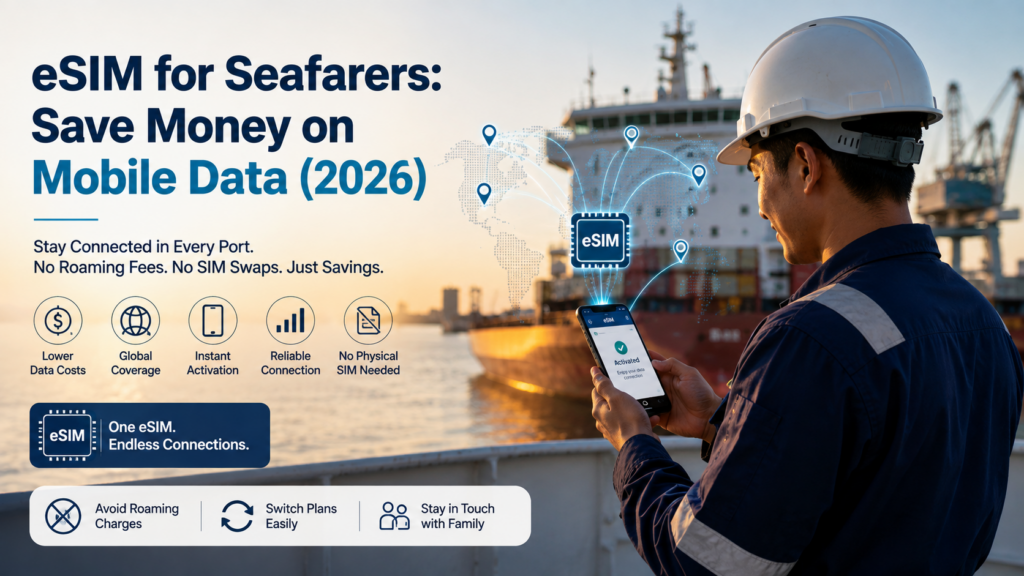
Staying in touch with family while working at sea shouldn’t cost more than the voyage itself. Yet for many seafarers, mobile data is one of the most unpredictable expenses of the job. Stay connected worldwide with eSIM help seafarers, offering easy activation, affordable data plans, and reliable internet access wherever your voyage takes you.
A crew member joins a vessel in one country, disembarks in another, and spends shore leave in a third all within a matter of weeks. Each stop used to mean the same routine: hunt for a local SIM shop, pay an activation fee, wait in line, and hope the phone unlocks without hassle. Skip that step, and international roaming charges can quietly add up to hundreds of dollars a month.
Port Wi-Fi doesn’t solve the problem either. It’s often slow, shared by dozens of crew members at once, or simply unavailable outside the terminal building.
This is where an eSIM changes the equation. It lets merchant navy crew, deck officers, marine engineers, and offshore workers activate mobile data in a new country in minutes, without buying a new SIM card or paying roaming fees.
In this guide, you’ll learn how an eSIM works, why it’s typically cheaper than roaming, how it compares to a physical SIM, and what to look for when choosing the best eSIM for merchant navy crew and seafarers.
Why mobile data costs are so high for Seafarers
Seafarers face a unique combination of travel patterns that make mobile connectivity expensive by default.
International roaming charges. Most home mobile plans are built for domestic use. The moment a phone connects to a foreign network, roaming rates apply often billed per megabyte, with costs that escalate quickly during a multi-country voyage.
Buying a new SIM card at every port. Some crew avoid roaming by purchasing a local SIM in each country. This works, but it means repeating the same process finding a shop, showing ID, and paying an activation fee every time the ship changes course.
Activation fees and paperwork. Many countries require local ID registration or passport verification to activate a prepaid SIM, which can be difficult to arrange during a short port call.
Changing phone numbers. A new local SIM usually means a new number, which disrupts contact with family, agents, and shipping companies until everyone is updated.
Poor airport and port pricing. SIM kiosks at airports and cruise terminals often charge a premium simply because travelers have limited time and few alternatives.
Unexpected charges. Data caps, throttled speeds after a threshold, or automatic roaming triggered by a phone’s default settings can all lead to surprise charges on the next bill.
Together, these costs make traditional connectivity one of the least predictable line items in a seafarer’s personal budget and one of the easiest to fix with the right approach.
What is an eSIM?
An eSIM (embedded SIM) is a digital SIM card built into a smartphone, tablet, or smartwatch. Instead of inserting a physical plastic chip, you scan a QR code or install an app to download a mobile data plan directly onto your device.
How it works.
The eSIM stores your mobile network profile in the phone’s built-in chip. Once installed, it connects to a local or regional network the same way a physical SIM would but without any hardware to insert, lose, or damage.
How activation works.
After purchasing an eSIM plan online, you receive a QR code by email. Scanning it installs the profile on your device in a few minutes. Some providers also support manual entry or one-tap installation through an app.
eSIM vs physical SIM, in short.
A physical SIM is a removable card tied to one carrier at a time. An eSIM is reprogrammable software, which means a single device can store multiple eSIM profiles and switch between them without opening the SIM tray.
Compatible phones.
Most recent iPhone, Samsung Galaxy, Google Pixel, and other flagship Android models released in the past few years support eSIM. Availability can vary by device model and region, so it’s worth confirming compatibility before departure.
10 ways an eSIM helps Seafarers save money
1. Avoid Roaming Fees
Once an eSIM data plan is active for the country or region you’re in, your phone uses that plan instead of your home carrier’s roaming service, sidestepping per-megabyte roaming charges entirely.
2. Buy Local or Regional Plans Online
Instead of relying on whatever SIM shop happens to be near the port, you can compare and purchase a plan in advance from your phone or laptop, often at a lower price than in-person options.
3. Keep Your Home SIM Active
Because an eSIM runs alongside your existing SIM, you can keep your home number active for calls and SMS, including WhatsApp verification, while using the eSIM purely for data.
4. Switch Countries Instantly
When the ship reaches a new port, there’s no need to search for a shop. You simply install or activate the next eSIM plan before or after arrival, depending on the provider.
5. No Physical SIM Costs
There’s no plastic card to buy, no SIM tray tool to carry, and no risk of losing a tiny SIM card in a cabin drawer between voyages.
6. Cheaper Regional Plans
Many eSIM providers offer regional bundles covering multiple countries useful for a route that passes through several ports in the same region, such as Southeast Asia or the Mediterranean.
7. Flexible Validity Periods
Plans are typically available in short-term and longer-term validity windows, so you can match the plan length to your actual time in port rather than paying for unused days.
8. Multiple Profiles on One Device
Modern eSIM-compatible phones can store several eSIM profiles at once, making it easy to keep separate plans ready for different regions on your rotation.
9. Easy Recharge
Running low on data doesn’t mean starting over. Most providers let you top up or purchase a new plan online in a few taps, without reinstalling anything.
10. Instant Activation
Because everything happens digitally, there’s no waiting for a shop to open or a shift to end a plan can often be active within minutes of purchase.
eSIM vs Physical SIM
| Factor | eSIM | Physical SIM |
| Price | Often lower for short-term travel plans | Can include hidden activation and registration fees |
| Convenience | Installed digitally in minutes | Requires finding a shop and physical card swap |
| Roaming | Avoided by switching to a local/regional plan | Roaming charges apply unless a new SIM is bought |
| Activation | QR code or app-based, self-service | Often needs in-person ID verification |
| Coverage | Depends on provider’s network partnerships | Depends on the specific SIM purchased locally |
| Security | Cannot be physically removed or stolen | Can be lost, damaged, or stolen |
| Environmental impact | No plastic waste | Plastic card and packaging per country visited |
| Switching countries | Can store multiple profiles, switch digitally | Requires a new physical card each time |
Callout: An eSIM doesn’t replace your home number it runs alongside it, so you can keep receiving calls and messages on your usual SIM while using the eSIM for data.
Real Example: A Multi-Port Voyage
Consider an Indian seafarer joining a vessel that calls at Singapore, then continues to Japan, South Korea, a European port, and finally the UAE before the crew change.
Under the old approach, this route would typically mean either paying roaming rates across four or five different networks, or hunting down a local SIM vendor at each stop often during limited shore leave.
With an eSIM, the same seafarer could instead activate a regional Asia plan covering Singapore, Japan, and South Korea for that leg of the voyage, switch to a Europe-wide plan before reaching the European port, and then activate a UAE-specific plan for the final stretch. Each switch happens from the phone itself, without needing to locate a shop or lose the home number in the process.
The exact savings will vary depending on the plans chosen and how much data is used, but the underlying advantage is consistent: fewer stops, fewer separate purchases, and no dependence on port-side SIM vendors.
Common Mistakes Seafarers Make
- Buying airport SIMs at premium prices. Airport and cruise terminal kiosks often charge more than online alternatives simply because of limited time and options.
- Leaving roaming turned on by default. Many phones automatically roam onto a foreign network unless data roaming is manually managed or an eSIM plan is installed first.
- Waiting until arrival to sort out connectivity. Shore leave is short. Arranging a plan in advance avoids losing valuable time to setup.
- Running out of data mid-port-call. Without monitoring usage, it’s easy to exhaust a plan before shore leave ends, especially with video calls home.
- Ignoring device compatibility. Not every phone supports eSIM, and older or region-locked devices may need to be checked before relying on this method.
How to Choose the Best eSIM for Merchant Navy Crew
Coverage. Confirm the provider supports the countries and regions on your voyage route, including any regional bundles for multi-port legs.
Price. Compare cost per GB and total plan price against local SIM options and standard roaming rates.
Validity. Match the plan’s active period to your expected time in port or region, rather than defaulting to the longest option.
Data allowance. Consider how you’ll use the connection messaging and calls need far less data than video calls or streaming.
Support. Look for responsive customer support, ideally available across time zones given irregular shore leave hours.
Activation. Check whether the plan can be installed before departure and activated later, which is useful when Wi-Fi access before joining a ship is limited.
Compatibility. Verify your specific phone model supports eSIM before purchasing.
Network quality. Where possible, check which local network partner the eSIM uses in each country, since coverage quality can vary between carriers.
Why Choose Mapians eSIM help Seafarers
Mapians offers eSIM data plans covering 190+ destinations, built with the realities of international travel and seafaring schedules in mind.
- 190+ destinations country and regional plans for the routes seafarers actually sail
- Instant activation install your eSIM before joining your ship, then activate it when you’re ready to use it
- Flexible plans validity periods designed to match short port stays as well as longer rotations
- Secure checkout purchase and manage your plan online without needing to visit a local vendor
- Compatible devices support across major eSIM-enabled iPhone, Samsung, and Google Pixel models
- Easy online purchase buy an eSIM online from your cabin, home, or airport lounge before you sail
Mapians is built around the idea that connectivity shouldn’t depend on which port you happen to be standing in.
FAQ about eSIM help Seafarers
How can eSIM help seafarers save money on mobile data?
Seafarers save the most by avoiding roaming charges and airport SIM purchases, and instead using an eSIM to activate local or regional data plans online. This removes per-port SIM costs and lets crew compare prices in advance rather than paying premium rates on arrival.
What is an eSIM?
An eSIM is a digital SIM card built into a phone that stores a mobile network profile without a physical card. You install it by scanning a QR code, and it connects to a chosen network just like a traditional SIM, but without needing a card to insert or swap.
Is an eSIM cheaper than roaming?
In most cases, yes. Roaming rates are typically charged at a premium by your home carrier, while an eSIM lets you buy a local or regional plan directly, often at a lower cost per GB. Actual savings depend on the specific roaming rate and eSIM plan compared.
Can merchant navy crew use one eSIM in multiple countries?
Yes, many eSIM providers offer regional plans covering several countries on one profile, and phones can store multiple eSIM profiles at once. This allows crew to switch coverage as the ship moves between regions without buying a new SIM each time.
Can I keep my WhatsApp number?
Yes. An eSIM is typically used for data alongside your existing SIM, so your home number and any accounts tied to it, including WhatsApp, stay active. The eSIM doesn’t replace your number unless you choose a plan that includes one.
Can I install my eSIM before joining my ship?
Yes, most providers allow you to purchase and install the eSIM profile in advance, using Wi-Fi at home or in port. You can then activate the data plan itself when you’re ready to use it, so it’s ready the moment you need it.
Does an eSIM work at sea?
An eSIM connects through cellular networks, which are available in port and near coastlines, not in the open ocean. While fully at sea, connectivity typically depends on the ship’s satellite or shipboard internet system rather than any SIM, physical or digital.
Which phones support eSIM?
Most recent iPhone, Samsung Galaxy, and Google Pixel models support eSIM, along with several other Android flagships released in recent years. Compatibility can vary by exact model and region, so it’s worth checking your device settings before purchasing a plan.
What is the best eSIM for merchant navy crew?
The best eSIM for merchant navy crew is one with strong coverage across your specific voyage route, flexible validity periods, and straightforward online activation. Providers like Mapians, which cover 190+ destinations with regional plan options, are built for this kind of multi-port travel.
How do I avoid roaming charges?
Turn off automatic data roaming on your phone and install an eSIM data plan for the country or region you’re visiting before you need to use data. This way, your phone connects through the eSIM’s local network instead of defaulting to an expensive roaming connection.
Authoritative Sources
For readers who want to understand the technical and industry standards behind eSIM and maritime connectivity:
- GSMA the global industry body that maintains the technical standards eSIM technology is built on.
- International Telecommunication Union (ITU) the United Nations agency responsible for international telecommunications coordination, including mobile network standards.
- International Maritime Organization (IMO) the UN agency responsible for the safety and regulation of international shipping, relevant to understanding connectivity requirements for crew welfare at sea.
Conclusion
Between roaming charges, airport SIM prices, and the hassle of re-registering a new number at every port, traditional mobile connectivity was never built for a life spent moving between countries. An eSIM fixes that by putting the whole process comparing plans, activating coverage, switching regions directly on your phone.
For merchant navy crew, deck officers, marine engineers, and offshore workers, that means fewer surprises on the bill and less time spent chasing a SIM shop during limited shore leave.
If your next voyage takes you through multiple ports, it’s worth setting up your connectivity before you sail rather than after you arrive. Buy your eSIM online with Mapians and have your data plan ready before you even step aboard.